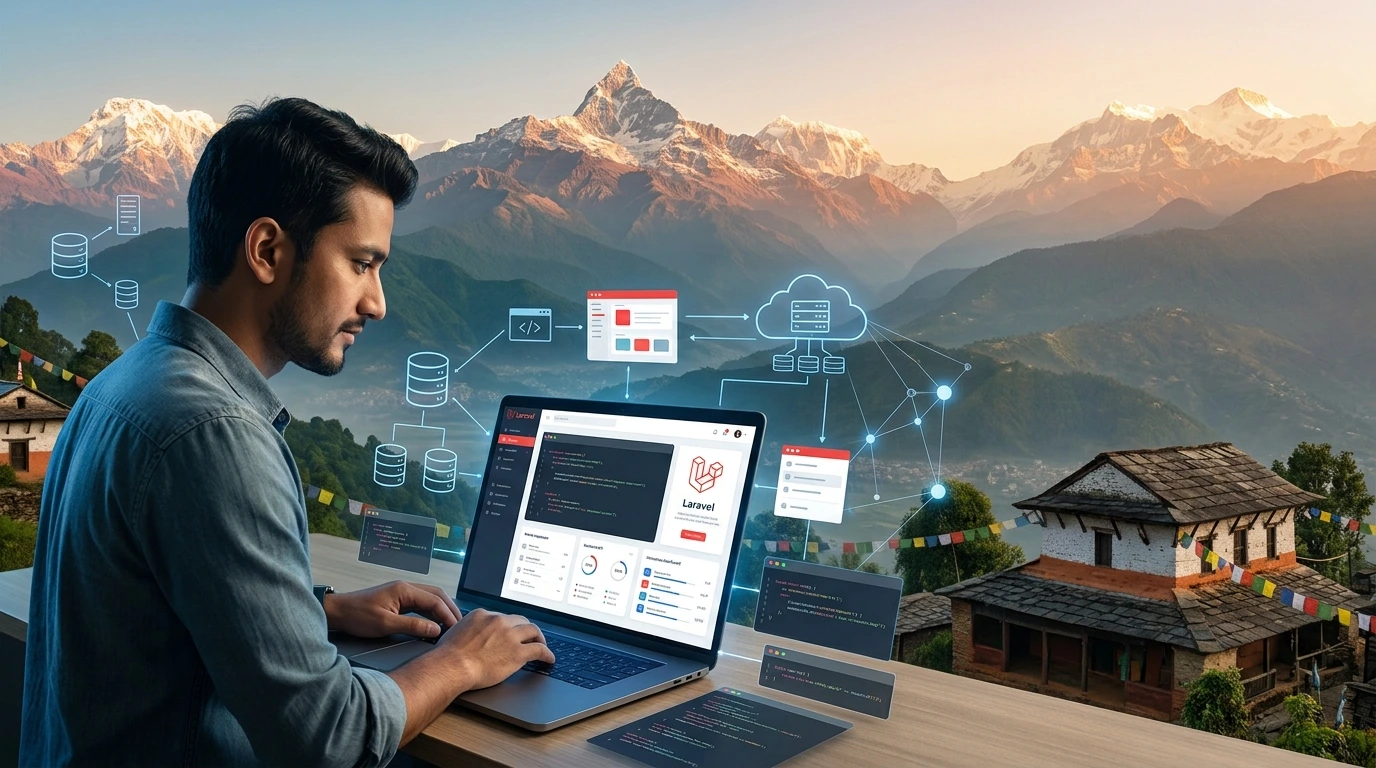
Choosing the right technology is important when building a web application, but choosing the right developer is just as important. Laravel has become a popular choice for businesses that want to build secure, scalable, and maintainable PHP applications without making development unnecessarily complicated.
However, Laravel itself is only part of the equation. A successful project also depends on having the right developer who can understand your business requirements, evaluate the project scope, and make the right technical decisions from the beginning.
A good Laravel developer does more than write controllers, models, APIs, and database queries. They should be able to look at the complete project and think about how the application should be structured. Based on the project's scope, business requirements, expected traffic, integrations, future growth, and budget, the developer can help choose an architecture that is practical for the project rather than adding unnecessary complexity.
This is one reason many startups, businesses, and agencies consider hiring a Dedicated Laravel Developer from Nepal.
A dedicated developer works closely with your team and focuses on your project rather than moving between unrelated short-term tasks. By staying involved throughout the development process, the developer can understand your business logic, existing technology, project goals, and future plans. This deeper understanding can lead to better technical decisions, cleaner architecture, and a more consistent codebase.
The right developer can also become a technical partner during the project. They can help you decide how different parts of the application should communicate, how the database should be structured, whether a simple Laravel application is enough or a more advanced architecture is justified, how APIs and third-party services should be handled, and how the system can be prepared for future changes.
Nepal has a growing technology community with developers working on web applications, APIs, business systems, dashboards, eCommerce platforms, and other custom software projects. Many Nepali developers also work with international clients and are experienced with remote collaboration and modern development practices.
As a Laravel and Full Stack Developer from Nepal, I have worked on different types of web applications, API based applications including healthcare, finance, SMEs, e-commerce, real estate, education, government, auction and bidding platforms, custom business applications, APIs, administrative dashboards, management systems, and a wide range of other business domains. These projects have taught me that successful development is not simply about writing Laravel code. It is about understanding the problem behind the software, choosing the right technical approach, and building a system that can remain reliable and maintainable as the business grows.
In this article, we will explore what a dedicated Laravel developer actually brings to a project, why businesses consider hiring Laravel developers from Nepal, how the right developer can help with architecture and technical decisions, and what you should look for when choosing a Laravel developer for your project.
Why Is Laravel a Popular Choice for Web Applications?
Laravel is a modern PHP framework designed to make web application development more organized, efficient, secure, and maintainable. It provides developers with a strong foundation for building applications without requiring them to create common functionality from the beginning.
PHP has several frameworks, including Symfony, CodeIgniter, Yii, CakePHP, and others. Each framework has its own strengths and can be a good choice depending on the project. Laravel has become particularly popular because it combines a clear development structure with a large ecosystem, useful built-in features, and tools that support the complete application development process.
One of the main advantages of Laravel is that it gives developers sensible conventions and ready-to-use tools. Instead of spending time creating basic functionality from scratch, developers can focus more on the actual business requirements of the application.
Laravel provides features and tools for areas such as:
Modern Laravel has also continued to improve beyond the traditional framework features. Its ecosystem now includes tools for areas such as real-time applications, application monitoring, queue management, automated deployment, performance monitoring, and more efficient development workflows.
This is important because modern web applications are rarely just a collection of web pages. A business application may need user roles, APIs, background processing, scheduled tasks, notifications, third-party integrations, reporting, file processing, payment workflows, and many other moving parts.
Laravel provides a common foundation for bringing these pieces together.
Laravel Is More Than Its Built-In Features
The value of Laravel is not simply the number of features available. The bigger advantage is how those features can be used together to create a practical application architecture.
Example
A project may require users to upload files, process those files in the background, send notifications when processing is complete, store information in a database, expose some data through an API, and provide an administrative dashboard.
Laravel already provides tools that can support many of these requirements. A developer can use queues for long-running processes, events and notifications for application communication, Eloquent for database interaction, caching for frequently accessed data, and Laravel's authentication and authorization features for controlling access.
The developer's job is to decide how and when to use these features.
This is where the experience of the Laravel developer becomes important.
Not every project needs a complicated architecture. A small business application may work perfectly well with a straightforward Laravel structure. A larger application with many users, integrations, background processes, or high traffic may require a more carefully designed architecture.
The right approach should come from the project scope and business requirements, not from trying to use every feature the framework provides.
The Right Architecture Makes Laravel More Valuable
Choosing Laravel is only the beginning. How the application is structured can have a much bigger impact on its long-term maintainability.
Before development starts, an experienced Laravel developer should understand questions such as:
- What problem is the application solving?
- Who will use the system?
- What are the main business workflows?
- How much data will the application handle?
- Are there external APIs or third-party services?
- Will background processing be required?
- What level of security is needed?
- Does the application need real-time functionality?
- How might the application grow in the future?
- Which parts should remain simple, and which parts need stronger separation?
The answers help determine the appropriate architecture.
For some applications, a well-structured Laravel monolith may be the best solution. For another project, the developer may need to introduce APIs, queues, caching, real-time communication, or separate services as the requirements grow.
The goal is not to create the most complicated architecture possible. The goal is to create an architecture that is appropriate for the project's current needs and flexible enough for its expected future.
Where Laravel Can Make a Difference
Consider a business application with a number of connected workflows. Users may create records, administrators may review them, notifications may need to be sent, reports may be generated, and some tasks may need to run automatically.
Without a good framework and structure, developers may end up writing repetitive code and creating different solutions for similar problems.
Laravel provides conventions and reusable tools that can help keep these parts organized. This can make development easier for the initial developer and also make the codebase easier for another developer to understand later.
The same idea applies to more specialized systems.
Example: an auction or bidding platform
An auction or bidding platform may require users, auction items, bidding rules, bid history, notifications, automated auction closing, administrative controls, payment-related workflows, and reporting. The difficult part is not simply creating a "Place Bid" button. The application must correctly enforce business rules, manage time-sensitive actions, protect data, and keep different parts of the system consistent.
Laravel can provide the foundation for building these features, but the architecture and implementation decisions still depend on the developer.
And this is not limited to auction applications. The same principle applies to:
A Good Laravel Developer Makes the Framework Work for the Project
A framework gives developers tools. An experienced developer knows how to use those tools appropriately.
A good Laravel developer should not simply start building features as soon as the project begins. They should first understand the requirements and think about how the different parts of the application will work together.
This can include decisions about:
These decisions may not always be visible to the end user, but they can have a major impact on the project later.
Makes it easier to add new features, fix problems, onboard new developers, test changes, and maintain the application after launch.
Has the opposite effect, where even a small change becomes difficult and risky.
This is why choosing Laravel and choosing the right Laravel developer should be considered together.
Laravel provides the foundation and tools. The developer brings the understanding needed to select the right tools, design the right architecture, and build a solution around the actual business requirements.
When the framework, architecture, and development approach are chosen correctly from the beginning, the application becomes easier to work with not only during development but also throughout its future lifecycle.
What Does a Dedicated Laravel Developer Actually Mean?
The word "dedicated" is important.
A dedicated Laravel developer is not simply a developer who knows Laravel. It usually means a developer who is assigned to your project and spends focused time working with your application, understanding your requirements, following the project's architecture, and supporting its ongoing development.
This is different from hiring a developer for a small, isolated task.
When someone is hired only to complete a particular feature, their focus may be limited to finishing that task. A dedicated developer, on the other hand, has the opportunity to understand the application as a whole.
A dedicated developer has the chance to learn:
- How your business works
- Why certain features are needed
- How different parts of the system are connected
- What technical decisions have already been made
- What the application may need in the future
This deeper understanding can make a significant difference to the quality of the software.
A reporting dashboard
The developer should not only think about how to display charts and tables, but also understand what decisions the business expects to make from those reports. This influences the data structure, queries, filters, permissions, and overall design of the feature.
An API
The developer should understand who will consume it, what data needs to be available, how authentication should work, and what information needs to be protected.
An auction or bidding workflow
The developer needs to understand the business rules, timing, user actions, notifications, and possible edge cases rather than simply creating a page where users can place bids.
The same principle applies to almost every type of application.
A dedicated Laravel developer can become familiar with the project's architecture and make technical decisions with the existing system in mind. Instead of treating every new feature as a separate task, the developer can consider how that feature will affect:
Why Hire a Laravel Developer from Nepal?
Nepal has a growing software development community, with developers working with businesses and clients from different parts of the world. For companies looking for remote Laravel development, Nepal can offer a combination of technical skills, flexible engagement options, clear communication, and competitive development costs.
But choosing a developer should not be based on location alone.
The important question is whether the developer can understand your business requirements, work with your existing technology, make sensible architectural decisions, and build software that remains maintainable as the project grows.
Here are some of the practical reasons why hiring a Laravel developer from Nepal can be worth considering.
Cost-Effective Development Without Sacrificing Quality
Cost is often an important consideration for startups, small businesses, and companies building a custom application.
Development rates in Nepal can be more competitive than those in countries such as the US, UK, Australia, and Western Europe. This is mainly related to differences in local operating costs and market rates, rather than an assumption about the quality of the work.
However, choosing the cheapest developer is not necessarily the best decision. A developer who delivers quickly but creates poor architecture or difficult-to-maintain code can become more expensive later. Fixing technical debt, rewriting features, or rebuilding parts of an application can cost much more than making good decisions from the beginning.
Strong Communication With International Clients
Good communication is one of the most important parts of remote software development. Many Nepali developers work with international clients and use English regularly for requirements, documentation, meetings, project discussions, and technical communication.
For a Laravel project, communication is not only about understanding what feature a client wants. It is also about asking the right questions when requirements are unclear.
Instead of simply building a requested feature, a good developer may ask:
- Why is this feature needed?
- Who will use it?
- What should happen in unusual situations?
- Does it affect any existing functionality?
These questions can prevent misunderstandings and reduce unnecessary rework. Clear communication also helps when discussing architecture, project scope, priorities, deadlines, and technical limitations.
A Practical Time Zone for Remote Work
Nepal's time zone can work well for remote development with clients across Asia, Australia, Europe, and other regions. More importantly, successful remote collaboration does not depend entirely on having the same working hours.
A good process can combine scheduled meetings with asynchronous communication, task management, documentation, Git-based development, and regular progress updates. The goal is a predictable workflow where the client knows what is being worked on, what has been completed, and what needs attention next.
For long-term projects, establishing a simple communication rhythm is often more important than having several hours of overlapping work time every day.
Strong Technical Foundation in Laravel and PHP
A good Laravel developer should understand more than Laravel's syntax. Laravel is built on PHP, so a strong understanding of PHP, object-oriented programming, databases, SQL, APIs, authentication, security, Git, and server-side development is important when working on a serious application.
Laravel provides many useful features and conventions, but the developer still needs to decide how those features should be used: how business logic should be organized, how the database should be structured, when to use queues or caching, how APIs should be designed, and how different parts of the application should communicate.
The framework provides the tools. The developer decides how to use them.
Experience With Custom Business Applications
Many businesses need software that fits their own processes rather than a generic solution. Laravel can be used to build many types of custom applications, including:
The challenge with these applications is often understanding the business rules rather than simply writing code. My experience includes working on different types of custom web applications, business systems, APIs, administrative applications, and applications with specialized workflows such as auction and bidding functionality.
I consider auction and bidding systems one example of working with complex business rules, rather than the focus of my overall development experience. The same principles of understanding workflows, handling edge cases, protecting data, and designing maintainable architecture apply to many other business applications.
Full-Stack Knowledge Can Reduce Communication Gaps
Modern web applications often involve several layers:
When a developer understands more than one part of this stack, it can make development and troubleshooting easier. My primary experience is with Laravel and PHP, along with technologies such as React.js, Node.js, MySQL, APIs, and related web technologies.
For example, if a React application is not receiving the expected response from a Laravel API, a developer with full-stack knowledge can investigate both sides of the problem. The issue could be related to the frontend request, API response, authentication, backend logic, or database query.
This does not mean one developer should handle every part of a large project. Larger applications may benefit from separate frontend, backend, DevOps, QA, and design specialists. But for startups and small-to-medium projects, having a developer who can understand the broader technology stack can make communication and development more efficient.
Practical Experience With Real-World Problems
Knowing how to create a Laravel model, controller, migration, or API is only the beginning. Real applications introduce problems that tutorials cannot always prepare you for. Requirements change, users behave unexpectedly, third-party services fail, databases become larger, and new business rules are introduced.
A developer needs to think about these situations before they become production problems. For example:
- What happens if two users perform the same action at nearly the same time?
- What happens if a payment succeeds but the callback fails?
- What happens if an external API becomes unavailable?
- What happens if a user refreshes the page during an important operation?
- What happens if an administrator changes data that another process is using?
Thinking about these situations can influence database transactions, validation, queues, error handling, security, and application architecture. This type of practical thinking is often more valuable than simply knowing every feature available in Laravel.
Flexible Engagement for Different Project Stages
Not every business needs the same development arrangement. A startup may need a developer full-time for an initial product. Another company may need part-time development while its internal team handles other areas. A business with an existing application may need ongoing Laravel development and maintenance.
Depending on the project and agreement, remote Laravel development can support different engagement models, including dedicated, full-time, part-time, or project-based work. A flexible approach can be useful when project requirements change over time.
The important thing is to choose an engagement model that matches the project's scope, expected workload, communication needs, and long-term goals.
Better Focus on Long-Term Maintainability
The first version of an application is rarely the final version. After launch, businesses usually add features, change workflows, integrate new services, and respond to user feedback. The developer therefore needs to think about what happens after the initial release.
A well-structured Laravel application can make future development easier. Sensible database design, clear business logic, appropriate use of Laravel features, validation, authentication, testing, and separation of responsibilities can all contribute to a healthier codebase.
This is another reason a dedicated developer can be valuable. As they become familiar with the application, they can make new technical decisions based on the existing architecture rather than treating every feature as an isolated task.
Choosing the Right Developer Still Comes First
Nepal can provide access to skilled and flexible remote development talent, but the country itself should not be the deciding factor. The right Laravel developer should understand your business problem, ask useful questions, evaluate the project scope, recommend an appropriate architecture, communicate clearly, and think about the application's future—not just its first release.
In the end, the real benefit of hiring a Laravel developer from Nepal is not simply the location or development cost. It is finding the right technical partner who can turn your requirements into reliable, maintainable software and continue improving it as your business grows.
What Should You Look for When You Hire a Laravel Developer?
Choosing a developer should involve more than looking at a list of technologies. Here are some questions I recommend asking.
Does the developer understand your business?
Can they explain technical decisions?
Have they worked on similar problems?
How do they handle changing requirements?
Do they think about security?
Can they maintain the application after launch?
What Laravel Development Services Can You Expect?
Depending on the project, Laravel development services can cover much more than creating a basic website. Some common services include:
The exact development process depends on the project. A small internal application may need a very different approach from a large public platform with thousands of users.
My Approach as a Freelance Laravel Developer
As a freelance developer, I have learned that successful projects depend on communication as much as technology. My approach starts with understanding the requirements. I want to know what the application is supposed to accomplish, who will use it, what problems it solves, and what the important workflows are.
From there, the application can be broken down into smaller components. For example, an auction platform might require:
Breaking the project into logical parts makes development easier to manage and test.
I also believe in avoiding unnecessary complexity. There is often a temptation in software development to use every new technology available. In reality, the best solution is usually the one that solves the problem reliably while remaining understandable and maintainable.
When Should You Hire a Dedicated Laravel Developer?
You might consider hiring a dedicated Laravel developer when:
- You are starting a custom web application.
- Your existing Laravel application needs ongoing development.
- You have a business process that cannot be handled by standard software.
- You need a Laravel API.
- You are building a SaaS platform.
- You need a custom admin panel.
- You need to integrate several external services.
- You have accumulated technical debt in an existing application.
- You need someone who can work across Laravel and frontend technologies.
- You expect the project to evolve over time.
For a very small one-time task, a dedicated developer may not be necessary. But if the application is central to your business, having a developer who understands the project over time can provide significant value.
Dedicated Developer vs. Development Agency
Both approaches have advantages. The right choice depends on your project size, budget, timeline, and internal team.
Development Agency
May provide designers, developers, project managers, QA engineers, and other specialists under one organization. If you need a large team working on a complex enterprise platform, an agency may make more sense.
Dedicated Freelancer
A more direct working relationship. You communicate directly with the person writing the code rather than going through several layers. If you need an experienced developer who can take ownership of a Laravel application and communicate directly with you, a dedicated freelancer can be a strong option.
Common Mistakes Businesses Make When Hiring Developers
Choosing entirely based on price.
Starting development without clearly defining the problem.
Focusing heavily on visual features while overlooking database design, permissions, error handling, security, and scalability.
A few practical recommendations
- Define the core business requirements before development.
- Start with the most important functionality.
- Discuss the expected users and usage patterns.
- Agree on communication and update processes.
- Use version control.
- Keep staging and production environments separate.
- Plan for backups.
- Discuss maintenance before launch.
- Make security part of development from the beginning.
- Avoid unnecessary features in the first version.
Good software development is not only about writing code quickly. It is about making sensible decisions throughout the project.
Frequently Asked Questions
Why should I choose a Dedicated Laravel Developer from Nepal?
How much does it cost to hire a Laravel Developer?
Can a Laravel developer handle frontend development too?
Can you work on an existing Laravel application?
Is Laravel suitable for a startup or new business?
Is a Dedicated Laravel Developer from Nepal Right for Your Project?
Choosing a developer is ultimately about more than location or technology. You need someone who understands the business problem, communicates clearly, writes maintainable code, and can stay involved as the application evolves.
Laravel is a powerful choice for building custom web applications, APIs, business management systems, marketplaces, dashboards, and many other types of software. Nepal can also be a practical location from which to hire remote development talent.
As a freelance Laravel and Full Stack Developer from Nepal, I work with technologies including Laravel, PHP, Node.js, React.js, MySQL, and APIs. My experience includes auction systems, bidding platforms, custom web applications, admin panels, APIs, and business management systems.
If you are planning a new Laravel application, improving an existing system, or looking for someone to take responsibility for ongoing Laravel development, I would be happy to discuss your requirements.
Looking to hire a Laravel developer for your project?
Get in touch and tell me what you are building, what problem you are trying to solve, and where you are currently stuck. We can then discuss the right technical approach, project scope, and next steps.