Build a secure, fast and scalable forward auction platform with custom bidding rules, real-time auction features, modern user interfaces, and complete backend architecture designed around your business requirements.
Request your free consult now
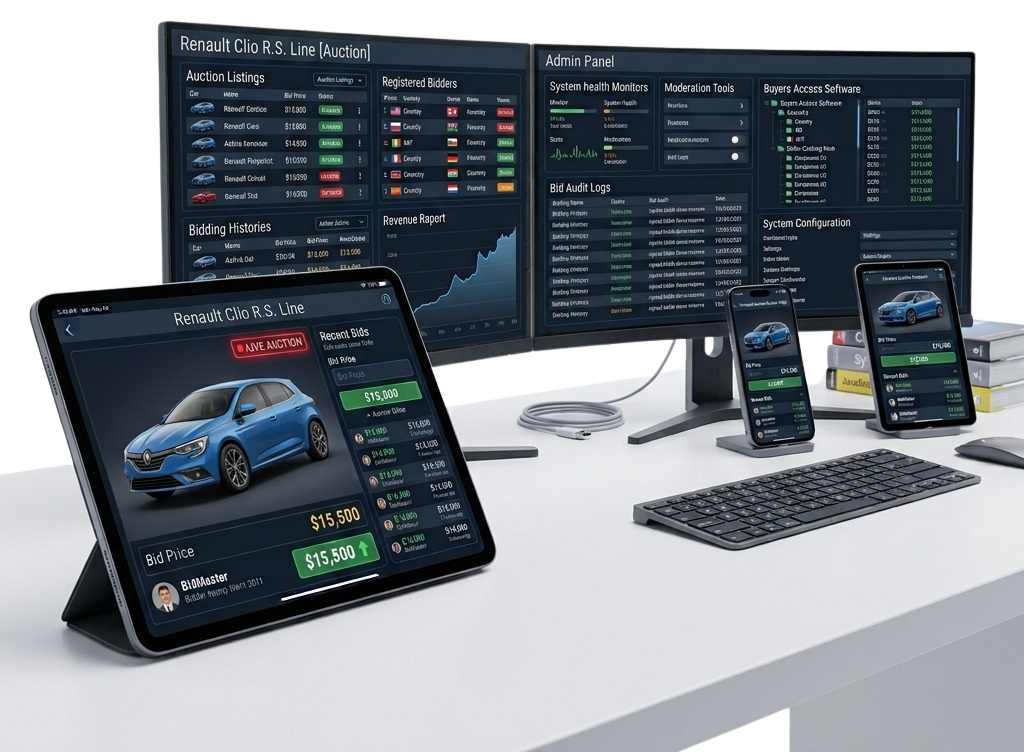
I'm a freelance full-stack developer with 20+ years of experience in software development and auction software. I specialize in building custom web applications and online auction platforms for businesses with unique operational requirements.
Forward auction software, also known as an English Auction, is one of the most common online auction formats. In a forward auction, a seller lists a product or asset with a starting price and auction duration, and registered buyers compete by placing higher bids. When the auction ends, the highest valid bidder wins the item at their final bid price.
I design and develop custom forward auction software based on your business requirements, rather than making your business adapt to a rigid, off-the-shelf auction platform. I work directly with clients to understand their auction process, business rules, user workflows, and long-term goals. I then turn those requirements into a practical, secure, and scalable software solution.
With more than 20 years of hands-on experience in auction software, I understand that an auction platform is much more than a product listing and a "Place Bid" button. A reliable auction system needs a well-designed bidding engine, accurate bid validation, real-time updates, auction timing, reserve price handling, proxy bidding, auction extensions, bidder management, payments, reporting, and secure post-auction workflows.
My full-stack experience allows me to work across the complete application, from system architecture and backend development to database design and modern frontend interfaces. Depending on your project requirements, I develop backend systems using Laravel, CodeIgniter, and Node.js, with MySQL, PostgreSQL, and MongoDB for database solutions. For frontend development, I work with React.js, Vue.js, and Tailwind CSS to create modern, responsive, and user-friendly interfaces.
This combination of auction domain knowledge and full-stack development experience allows me to build the platform as a complete system rather than treating the auction functionality as an isolated feature. I can design the architecture, develop the bidding and auction engine, create the Admin and Bidder interfaces, build APIs, integrate payment gateways and third-party services, and structure the database for performance, security, and future scalability.
Every auction business has its own rules and workflow. Depending on your business, you may need reserve prices, proxy or auto bidding, configurable bid increments, auction extensions, bidder verification, bidding deposits, multi-lot auctions, seller commissions, payment gateways, custom approval workflows, or integration with your existing business systems.
I build the software based on these requirements, with the flexibility to add new features or modify existing features as your business needs change.
My focus is to develop secure, scalable, high-performance, and maintainable forward auction software that provides a smooth experience for bidders and gives administrators complete control over the auction process.
Whether you are planning a B2B auction marketplace, vehicle auction platform, industrial equipment auction, machinery auction, surplus asset auction, or private auction system, I can design and develop the software based on your specific business requirements.
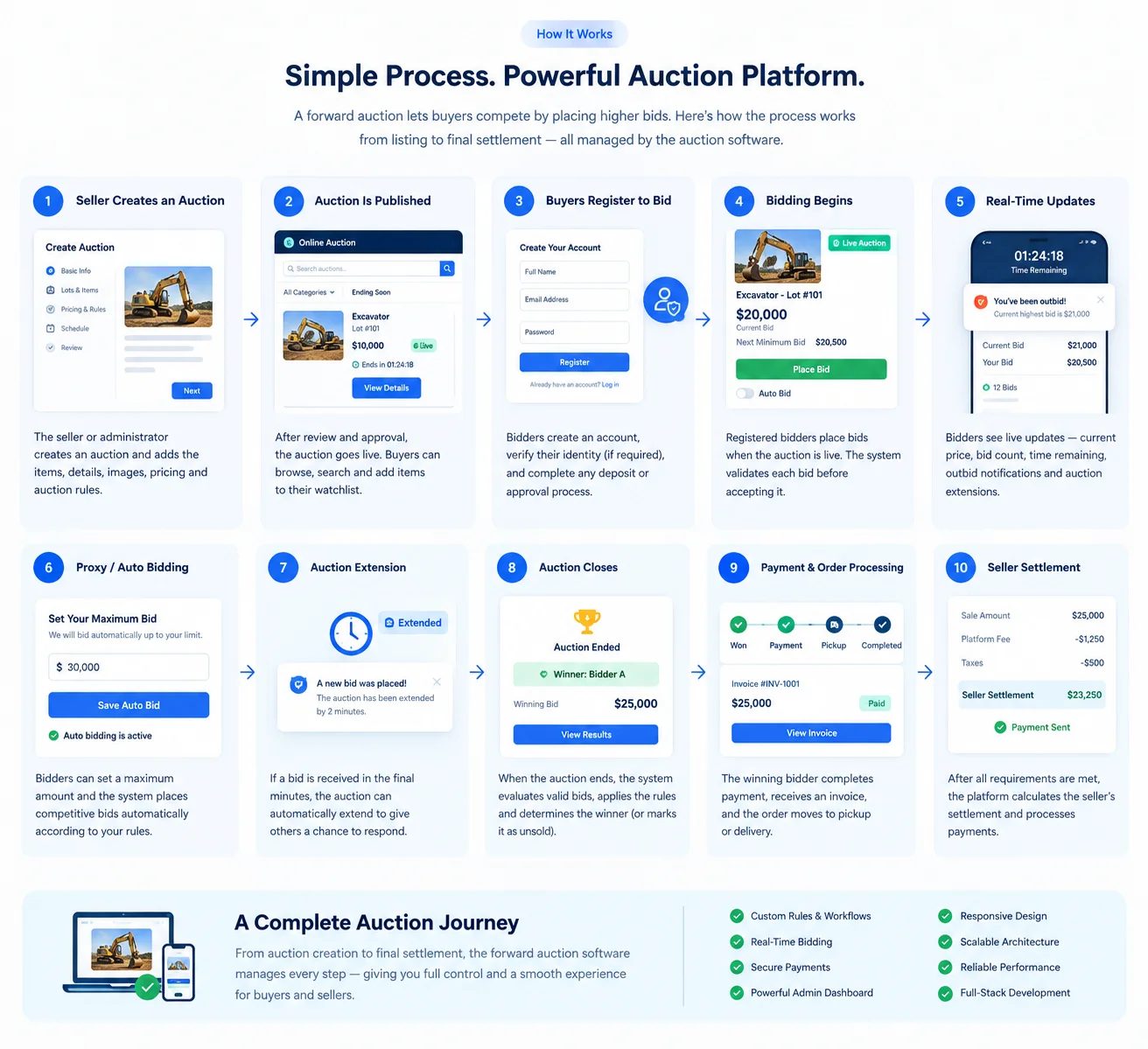
A typical forward auction follows a simple process, but the software behind it needs to manage many important rules and operations.
The seller or administrator creates an auction and adds the products or assets they want to sell, including title, description, images, documents, starting price, reserve price, bid increment, auction start and end time, location, and terms and conditions.
After the auction is reviewed and approved, it is published and made available to eligible bidders. Buyers can browse auctions, search for items, review the details and auction rules, and add lots to their watchlist.
Depending on the business requirements, buyers may need to create an account, verify their identity, accept the auction terms, or provide a refundable bidding deposit before they can participate.
When the auction goes live, registered bidders can start placing bids. The software checks each bid against the configured rules before accepting it — for example, requiring at least the minimum next bid amount.
The platform can update bidding information in real time without requiring a page refresh — current highest bid, bid status, time remaining, outbid notifications, and reserve status.
A bidder can enter the maximum amount they are willing to pay, and the system can automatically place bids on their behalf based on the configured bid increment and auction rules.
Some auctions use an extension rule to prevent last-second bidding. If a new bid is placed in the final minutes, the system can automatically extend the auction to give other bidders a chance to respond.
When the auction ends, the software evaluates valid bids and applies the configured rules — highest bid, reserve price, eligibility, and extensions — to determine the winner or mark the lot unsold.
After winning, the bidder moves to payment and order processing. The system can generate an invoice, collect payment, and calculate buyer fees, commissions, taxes, deposits, and delivery charges.
Once payment and other conditions are met, the platform calculates the seller's settlement, deducting the applicable platform commission and fees from the winning amount.
This allows the forward auction software to manage the complete process from creating an auction and accepting bids to closing the auction, processing payments, and completing the seller settlement.
Every forward auction platform has different bidding rules and business requirements. I build the software around those requirements and can include the features your business needs to manage auctions, bidders, sellers, payments, and the complete auction process.
The complete auction platform is built around your business requirements instead of forcing your business into a one-size-fits-all system, including seller management, bidder registration, auction scheduling, lot management, bidding, payments, reporting, and administration.
A live auction experience with real-time bid updates, current prices, bid history, countdown timers, and auction activity. The bidding engine validates every bid on the server and keeps the auction state consistent when multiple users are bidding at the same time.
Bidders enter the maximum amount they are willing to pay while the system automatically places competitive bids based on your configured bid increments and auction rules — no need to stay on screen and manually raise their bid.
Configurable registration, start, and end times, along with scheduled auctions, preview periods, registration windows, countdown timers, and other timing rules based on your business requirements.
Set a starting price for each item and add a reserve price when required. The system tracks whether the reserve price has been reached and applies the appropriate result when the auction closes.
Set minimum bid increments for individual items, lots, or categories, giving you control over how much each new bid must increase based on your auction rules.
Automatic auction extensions reduce last-second bidding. If a bid is placed during the final few minutes, the system can extend the auction for a configured period and give other bidders an opportunity to respond.
Manage multiple products or assets within a single auction event. Each lot can have its own price, bidding activity, images, documents, auction rules, and final result.
A controlled bidding environment with bidder registration, account verification, approval workflows, deposits, eligibility rules, and account status management. The level of verification can be configured based on the type and value of the items being auctioned.
Manage bidder accounts, registration status, verification, bidding eligibility, deposits, bid history, and account activity from the administration area, giving administrators better control over who can participate.
Sellers can submit products or assets, upload images and documents, provide item information, monitor bidding activity, and track completed sales. Seller access and permissions can be configured to your business workflow.
Manage the complete auction process from a central administration dashboard — create auctions, manage lots, review bidders, monitor live bids, control auction status, manage payments, view reports, and track seller settlements.
Bidders can search and filter auctions based on categories, prices, locations, auction status, and other criteria, and add interesting lots to a watchlist to easily return to them later.
The system tracks valid bids throughout the auction and automatically identifies the current highest bidder. When the auction closes, it applies the configured rules to determine the winning bidder.
Keep bidders and sellers informed with notifications for auction reminders, accepted bids, outbid notices, auction extensions, auction closing, winning bids, payment due dates, and payment confirmation. Email, SMS, push, and in-app notifications can be integrated based on your requirements.
Connect the auction platform with your payment and financial workflow. The system can handle winning bid amounts, buyer fees, seller commissions, taxes, deposits, invoices, payment status, refunds, and other applicable charges.
After the auction and payment process is completed, the system can calculate the seller's settlement based on the winning amount, platform commission, seller fees, taxes, and other configured deductions.
A clear view of auction performance through reports and dashboards tracking auction activity, bid volume, sales value, winning bids, unsold lots, buyer activity, seller performance, platform fees, payments, and settlements. Reports can be exported in formats such as Excel, CSV, or PDF.
Keep a record of important activities performed within the auction platform. Audit logs can track actions such as auction changes, bid activity, user actions, payment updates, and other important events. This helps administrators review activity and maintain a clear history of changes.
Control what different users can access and manage within the platform. Administrators, auction managers, sellers, bidders, and other staff members can have different permissions based on their roles and responsibilities.
Integrate payment gateways, email and SMS services, accounting systems, CRM systems, shipping services, identity verification services, and other third-party systems required by your business.
Build APIs to connect the auction platform with your existing website, mobile application, ERP, CRM, payment system, or other business applications.
A responsive auction interface that works across desktops, tablets, and mobile devices, so bidders can browse auctions, view item details, place bids, and manage their accounts from different devices.
Built with security, performance, and future growth in mind, structured to handle increasing numbers of auctions, bidders, bids, transactions, and other business data as the platform grows.
Forward auction software can be used by businesses and organizations that sell products, assets, equipment, or inventory through open and competitive bidding. Some common sectors include:
Cars, motorcycles, trucks, commercial vehicles, and fleet assets can be sold through scheduled online auctions.
Excavators, forklifts, generators, construction equipment, industrial machinery, tools, and other heavy assets can be sold through competitive bidding.
Land, residential properties, commercial buildings, and other real estate assets can be offered through online property auctions.
Auction houses, galleries, and private sellers can use online bidding to sell artwork, antiques, collectibles, rare items, and other valuable products.
Electronics, computers, mobile devices, refurbished products, gadgets, and other consumer goods can be sold through online auctions.
Businesses can auction overstock, returned products, surplus inventory, company assets, and other items they no longer need.
Government departments, public organizations, and institutions can use auction platforms to sell vehicles, equipment, surplus assets, and other property.
Businesses can buy and sell products, machinery, inventory, and other commercial assets through private or public B2B auction marketplaces.
Retailers, wholesalers, and distributors can use forward auctions to sell excess inventory, discontinued products, clearance stock, and other goods through competitive bidding.
Most developers who say they can build you an auction platform haven't actually dealt with the edge cases — two bids landing at almost the same second, a reserve price nobody explained clearly, an auction that needs to extend right as it's closing. I've been working through problems like these for over 15 years, on top of 20+ years writing software in general.
I'm an individual freelance developer, not a company with account managers passing messages along. When you want to ask how proxy bidding should behave, or change a rule halfway through the project, you're talking to the person actually writing the code.
You communicate directly with me throughout the project. There is no unnecessary communication gap between you and the person understanding your requirements and developing the software. This makes it easier to discuss business rules, explain changes, solve technical issues, and make decisions quickly.
Your first version of the platform may not contain every feature you eventually need. The software can be designed with a modular architecture so new features, integrations, user roles, auction types, and business workflows can be introduced as your platform grows.
Frontend, backend, database, and API work is handled together, so the bidding experience and the admin systems behind it work reliably as one application.
Every project has different requirements. Whether you are starting a new auction platform, developing software for your client, or working on an existing application, the development approach can be discussed around the actual scope and requirements.
I follow a clear development process to make sure the auction platform is built around your actual business requirements. The process can vary depending on the project, but I normally follow these steps.
I first understand your auction model, user roles, business rules, payment process, and day-to-day workflow. I also look at any existing systems that need to connect with the new auction platform.
I design the interfaces for administrators, sellers, and bidders based on how they will actually use the system. The goal is to keep the interface simple, clear, responsive, and easy to use.
I develop the main auction and bidding functionality, including bid validation, bid increments, proxy or auto bidding, auction timing, reserve prices, auction extensions, and winner determination.
I build the backend, database structure, APIs, business logic, integrations, notifications, queues, and administrative functions required for the platform.
If your auction requires live bidding, I implement real-time bid updates, auction activity, countdown timers, outbid notifications, and other features that need to update without refreshing the page.
I test the normal auction and bidding process as well as different situations that can cause problems. This includes multiple users bidding at the same time, duplicate requests, auction closing, auction extensions, payment failures, and user permission issues.
Once the platform is ready, I can help with deployment and continue working on the system after launch. This can include adding new features, integrating other services, improving performance, fixing issues, applying security updates, and maintaining the application as your business grows.
Yes. I develop custom Forward Auction platforms based on your bidding rules, item categories, user roles, and business requirements, rather than a fixed template.
Yes. If you already have a Forward Auction platform, I can review the existing system and work on improvements, new features, bug fixes, or maintenance.
Yes. I can continue working with you after launch on updates, bug fixes, additional features, and ongoing development as your platform evolves.
Yes, that's really the starting point of every project. I don't adapt your business to fit a fixed auction template — bid increments, reserve prices, registration rules, auction extensions, and the overall workflow are built around how your auction actually needs to run.
Depending on what your project needs, this can cover requirement analysis and planning, UI/UX design, the auction and bidding engine itself, backend and database development, APIs, payment gateway integration, admin and reporting tools, testing, deployment, and ongoing support after launch. Smaller engagements — a specific feature or a fix on an existing platform — are fine too.
On the backend, I typically work with Laravel, CodeIgniter, or Node.js, with MySQL, PostgreSQL, or MongoDB for the database. For the frontend, I build with React.js, Vue.js, and Tailwind CSS. The actual choice depends on your requirements, expected traffic, and whether the platform needs to connect with systems you already have.
No, and that's intentional. I build each platform from your actual requirements rather than reselling the same pre-made script to every client. It takes a bit longer than installing an off-the-shelf product, but you end up with bidding rules, workflows, and an admin system that actually match how your auction business operates.
It depends heavily on the scope — a straightforward single-lot auction site is a very different project from a multi-lot B2B platform with proxy bidding, deposits, and payment integrations. Once I understand your requirements, I can give you a realistic timeline rather than a generic estimate.
Yes. Multi-lot auctions are something I build regularly — each lot can have its own price, images, documents, bidding activity, and result, all running within the same auction event or across multiple auctions at once.
Yes. The bidding interface is built to work properly on desktops, tablets, and mobile devices, since a lot of real bidding activity happens on a phone in the final minutes of an auction.
Whether you are starting a new Forward Auction platform, adding auction features to an existing website, or improving an existing system, I am happy to discuss your requirements and find a practical way forward.
Whether you're starting fresh or enhancing an existing system, I offer custom software development services built to match your goals. From responsive web apps to powerful backend solutions and mobile integrations, explore how each service can help your business move forward with confidence.
I optimize your website or app for speed, mobile performance, and technical SEO to help you deliver faster experiences and build a strong foundation for better search visibility and user engagement.
I provide reliable maintenance and support to keep your applications secure, updated, and running smoothly. This includes bug fixes, content updates, performance improvements, backups, upgrades, and issue resolution.
I build fast, high-quality mobile apps using native Android and iOS, as well as modern frameworks like Flutter and React Native, to deliver a smooth, native-like experience while saving time and development cost.
Technologies and tools I use to deliver reliable, high-quality web and mobile application for clients worldwide.
PHP
Laravel
CodeIgniter
WordPress
Node.js
NestJS
JavaScript
TypeScript
React
React Native
Next.js
Vue.js
Bootstrap
Tailwind CSS
MySQL
MongoDB
PostgreSQL
HTML
CSS
jQuery
GitHub
VS Code
AI
Claude