Raise more funds with online Silent Auction Software and Charity Auction Software that makes bidding easy, increases participation, and helps nonprofit organizations run successful fundraisers. I offer secure and easy to use auction software for nonprofits, charities, schools, churches, foundations, and fundraising organizations. With over 20 years of experience in auction software and web development, I provide reliable tools to manage auction items, collect bids and payments, and keep bidders engaged.
Request your free consult now
Run your fundraising auction online with reliable Silent Auction Software designed to make bidding simple for everyone. The software gives nonprofits, charities, schools, churches, foundations, and other organizations the tools they need to manage an auction from one place.
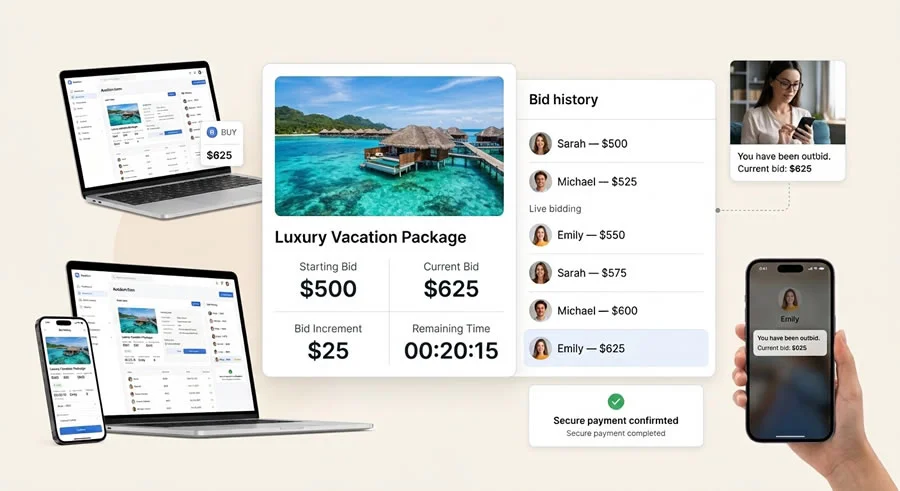
With online silent auctions, bidders can browse items, place private bids from their phone or computer, and receive notifications when they are outbid. They can continue bidding throughout the event without seeing the exact amounts submitted by other participants. When the auction ends, the highest valid bid wins.
The software also makes auction management easier for your team. You can add and manage auction items, set bidding rules, monitor activity, manage bidders, collect payments, and keep track of results. Bid information is handled securely, while the admin tools give you a clear view of what is happening during the auction.
I have more than 20 years of experience in auction software and web application development. My experience includes building systems that handle bidding, users, payments, reporting, inventory, and event workflows. This experience helps me provide a dependable online auction solution that is practical for both your team and your bidders.
Whether you are planning a fundraising gala, school auction, charity event, or regular online auction, Silent Auction Software can help you replace spreadsheets and manual processes with a simpler way to manage your event from registration to payment.
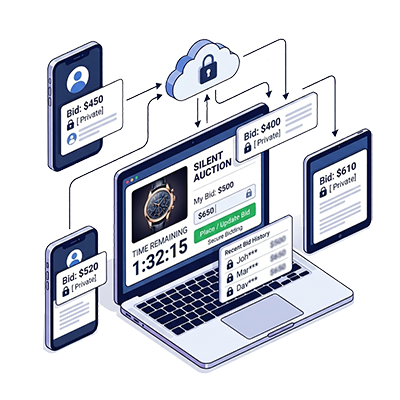
A silent auction runs on private bidding rather than public competition. Here is an example of how an auction can work from start to finish.
Each item or lot is added with a description, photo, starting bid, and minimum bid increment. You can set these rules per item based on its value.
Guests register and check in, either online ahead of time or on-site at the event, and are assigned a bidder number tied to their payment details.
Once the auction goes live, bidders can browse items and place bids from their phone, tablet, or a bid sheet at the event, depending on how you run it.
Each bid must meet the minimum increment above the current bid. Bidders can raise their own bid as many times as they like before the item closes.
Other bidders never see the exact amount someone has bid. Depending on your rules, they may see whether they're currently winning or outbid, without seeing the number.
Each item, or the whole auction, closes at a scheduled time. Bidding can close item by item or all at once, based on how your event is structured.
When bidding closes, the highest valid bid on each item wins. Winners can be notified automatically by email, SMS, or an on-screen announcement.
Winners can be charged automatically using the card on file from registration, or checked out manually, depending on how you want payment handled.
The rules in this example are not fixed. I can build them as configurable options in your Silent Auction Software, including bid increments, Buy It Now pricing, item closing schedules, registration requirements, and payment handling. This gives your team control over how the event actually runs instead of being limited to a fixed script.
Every fundraising event or auction house runs a little differently. That's why I build silent auction software around the way your event actually works. You can start with the core bidding features and add other functionality as your platform grows.
Keep every bid amount hidden from other bidders throughout the auction, so bidders only know whether they're currently winning, not what anyone else has offered.
Set a minimum bid increment per item so every new bid has to raise the price by a meaningful amount, keeping the bidding fair and predictable.
Let guests bid straight from their phones during the event, without needing to line up at a paper bid sheet.
Print a QR code next to each item so guests can scan it and go straight to that item's bidding page from their phone.
Manage every item from your admin panel, including photos, descriptions, categories, starting bids, and donor information.
Register bidders online ahead of time or check them in at the door, with a card on file so checkout after the auction is straightforward.
Charge winners automatically when the auction closes, or check them out manually at a payment desk, depending on your event.
Let a bidder purchase an item instantly at a set price instead of waiting for the auction to close, useful for popular items.
Run more than one fundraising event or auction from the same platform, each with its own items, bidders, and settings.
Notify bidders when they've been outbid or when an item they're watching is about to close, by email, SMS, or in-app alert.
Manage items, bidders, payments, and reports from one dashboard, with different access levels for staff and volunteers.
Give event staff, volunteers, and administrators access to only what they need, keeping bidder and payment data protected.
Keep a record of bidder and donor details, past participation, and giving history, so you can build stronger relationships year over year.
See how much each item raised, total funds collected, bidder participation, and other event data, exportable for your finance team.
Generate receipts that separate the fair market value of an item from the tax-deductible portion of a winning bid, where applicable.
Highlight event sponsors and item donors on the bidding platform, giving them visibility in exchange for their support.
Choose whether winning bid amounts are shown publicly once the auction ends, useful for building excitement or public accountability.
Run events and collect bids in the currency that makes sense for your organization and its bidders.
Make the bidding platform available in multiple languages so you can serve bidders in different regions or communities.
Connect the platform with Stripe, PayPal, local payment gateways, or other providers your organization already uses.
Help protect the auction from duplicate accounts and suspicious bidding activity, so the results stay fair.
Connect the platform with your CRM, donor management system, email marketing tool, or accounting software through APIs.
Keep a record of bids, payments, and admin actions across the platform, useful for accountability and troubleshooting.
Give bidders and event staff a way to get help quickly during the event, through live chat, support tickets, or a help desk integration.
Silent auction software fits any event or organization that wants to raise funds through private, competitive bidding rather than a fixed price tag. Some common users include:
Nonprofits can run silent auctions as part of galas and fundraising events, turning donated items into revenue for their cause.
Schools and parent associations can use silent auctions to fund programs, trips, and equipment through community fundraising events.
Art galleries and auction houses can run private bidding for artwork, antiques, and collectibles without public price competition.
Companies can run silent auctions at corporate events to support a chosen cause or employee giving program.
Sports clubs and teams can run silent auctions to raise funds for travel, equipment, or facility improvements.
Churches, temples, and other religious organizations can use silent auctions to fund community programs and outreach.
I have more than 20 years of experience building software for different business requirements. I work across backend development, frontend applications, APIs, databases, and custom business systems.
Silent auctions have their own quirks — bids that need to stay private, minimum increments, Buy It Now pricing, and closing rules that vary by item. I've been working through problems like these for over 15 years.
I plan the application structure before development starts, including database design, APIs, integrations, security, and scalability. This helps create a solid foundation for future development.
I handle both frontend and backend development, so the different parts of your application work together as one system. My backend experience includes Laravel, CodeIgniter, and Node.js, while I use React.js, Vue.js, and Tailwind CSS for modern frontend applications.
Security is considered from the beginning of development, including how bidder and payment data is protected and how bid privacy is enforced between users.
I build applications with future growth in mind. Database queries, API performance, caching, application structure, and server resources are considered so the system can handle busy events without slowing down.
I focus on writing organized and maintainable code rather than building something that only works for the first version. A clear codebase makes future changes, debugging, and feature development easier.
I test features throughout development to identify problems early, including bid privacy, closing timing, and payment flows, so the auction runs smoothly on event night.
Development doesn't end when the application is ready. I can help with server setup, deployment, environment configuration, production releases, troubleshooting, and ongoing technical improvements.
When you work with me, you communicate directly with the developer working on your project. Requirements, technical decisions, changes, and feedback can be discussed without going through account managers or multiple layers of communication.
You can start with the core features your event needs and add more functionality later. I structure applications so they can be extended as your requirements change.
Whether you need a complete application developed from scratch, a new feature added to an existing system, or ongoing development and maintenance, I can work according to the scope and requirements of your project.
I follow a clear development process to make sure the platform is built around your actual bidding rules and event goals. The process can vary depending on the project, but I normally follow these steps.
Yes. I build custom silent auction platforms based on your event or organization's requirements. Bid rules, registration, payment handling, and admin features can all be developed according to your needs.
Yes. I have a ready silent auction solution that can be customized to fit your event. If you need something different, I can also build a platform from the ground up around your preferred features and workflow.
Yes. Mobile bidding can be built so guests can browse items and place bids from their own phones, in addition to or instead of paper bid sheets.
Yes. A silent auction system can be designed for in-person events where guests use their phones to browse and bid while attending the event.
Yes. You can set a minimum bid increment for each item individually, based on its value, so higher-value items can require larger increments than smaller ones.
Yes. I can integrate payment gateways based on your organization and target region. This can include international providers, local payment gateways, and other payment services that provide suitable APIs.
Yes. The platform can be built to support multiple events or recurring auctions, each with its own items, bidders, and settings, managed from the same admin panel.
Yes. If you already have an event or donor management platform, I can work with the existing codebase instead of rebuilding everything, adding silent auction features where they're needed.
The development time depends on the features and complexity of the project. A basic platform for a single event takes less time than a full solution with recurring events, payment automation, and CRM integration. After reviewing your requirements, I can provide a more realistic development estimate.
I mainly work with Laravel, CodeIgniter, and Node.js for backend development, along with React.js, Vue.js, and Tailwind CSS for frontend applications. The technology stack is selected according to the project requirements rather than using the same setup for every project.
Yes. I can continue working on the application after launch for bug fixes, maintenance, security updates, performance improvements, and new feature development ahead of future events.
I usually start by understanding your event format, bidding rules, registration and payment requirements, user roles, and any existing systems that need to be connected. From there, I can help define the scope, technical approach, and development plan.
A silent auction isn't the right fit for every project. If you need public bidding, sealed price-reduction bidding, or a supplier procurement auction instead, I build those too.
Whether you're launching a new fundraising event, adding online bidding to an existing silent auction, or improving one you already run, I'm happy to discuss your requirements and find a practical way forward.
Whether you're starting fresh or enhancing an existing system, I offer custom software development services built to match your goals. From responsive web apps to powerful backend solutions and mobile integrations, explore how each service can help your business move forward with confidence.
I build reliable, secure, and efficient backend systems using modern frameworks. From API development to database design, I ensure your applications work seamlessly and scale with your needs.
I create visually appealing, conversion-driven designs that prioritize usability and your brand identity. Every layout is built to be responsive and intuitive for your target audience.
From product catalogs and shopping carts to payment gateways and order management, I develop secure, user-friendly e-commerce platforms tailored for small businesses and startups.
Technologies and tools I use to deliver reliable, high-quality web and mobile application for clients worldwide.
PHP
Laravel
CodeIgniter
WordPress
Node.js
NestJS
JavaScript
TypeScript
React
React Native
Next.js
Vue.js
Bootstrap
Tailwind CSS
MySQL
MongoDB
PostgreSQL
HTML
CSS
jQuery
GitHub
VS Code
AI
Claude