Freelance Next.js Developer in Nepal

Senior Next.js Developer & Software Architect with 20+ years of software development experience. I build custom websites and web applications with thoughtful architecture, strong performance, clean code, and a foundation that can grow with your business.

Request your free consult now

Build Your Next.js Web Application with an Experienced Developer and Software Architect

I am a freelance Next.js developer and software architect based in Nepal, with more than 20 years of experience in software development. I help businesses, startups, and teams build reliable websites and web applications that are fast, secure, easy to maintain, and ready to grow.

Next.js is a powerful framework built on React, but building a good application is about more than choosing the right technology. A successful project needs a clear structure, sensible technical decisions, and an understanding of how the application will be used today and how it may need to change in the future.

Before I start building, I take time to understand your requirements, users, content, data, integrations, and the way the application needs to work. I look at the overall architecture and decide how different parts of the application should be built, rather than simply adding pages and features as the project grows.

Depending on your requirements, I use Next.js features such as the App Router, Server Components, server-side rendering, static generation, dynamic rendering, and incremental regeneration where they provide a real benefit. The goal is not to use every feature just because it is available, but to choose the right approach for your project.

I also pay attention to performance, SEO, accessibility, security, and maintainability from the beginning. This helps create applications that load quickly, provide a good experience for users, and remain easier to manage as the project becomes larger.

Whether you need a professional business website, content platform, SaaS application, or a custom web application, I can help you plan the technical structure and build it with a practical approach.

My goal is simple: to build software that works reliably, is easy to understand and maintain, and gives you a solid foundation for future growth.
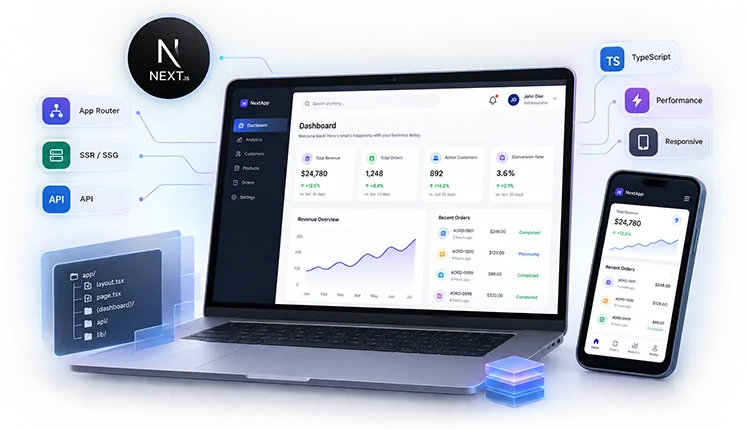

What I Build With Next.js

Next.js can be used for much more than a standard business website. I use it to build custom digital products and web applications where performance, maintainability, user experience, and future growth matter.

Business Websites & Corporate Platforms

Modern, responsive websites for businesses, organizations, and professional services that need a fast user experience, flexible content management, and a strong technical foundation.

SaaS & Web Applications

Custom SaaS platforms and web applications with user accounts, dashboards, subscriptions, workflows, reporting, notifications, and third-party integrations.

Customer Portals & Dashboards

Secure portals and dashboards where customers, employees, or administrators can manage accounts, documents, orders, reports, settings, and business information.

E-Commerce Applications

Custom e-commerce experiences with product catalogs, search, filtering, customer accounts, checkout integrations, order management, and connections with external services.

Content-Driven Websites

Blogs, publishing platforms, directories, knowledge bases, and other content-heavy websites where page performance, search visibility, and a smooth content experience are important.

Custom Business Systems

Purpose-built applications for specific business processes such as booking systems, marketplaces, management platforms, internal tools, and workflow automation.

Existing React & Next.js Applications

I also work with existing React and Next.js projects that need modernization, new features, performance improvements, refactoring, troubleshooting, or architectural changes.

Planning the Architecture Before Writing Code

In Next.js, a few early decisions shape how fast, secure, and easy to change your application will be. These are the ones I work out with you at the start.

Rendering

Server or browser?

Most of each page is rendered on the server with Server Components. This keeps it fast and keeps private logic off the user's device. I only send JavaScript to the browser for the parts people interact with, such as forms, filters, and live updates.

Caching

Static, cached, or live?

Each part of the application gets the right freshness. Pages that rarely change are built ahead of time. Products and articles are cached and refreshed when you edit them. Account and dashboard pages are rendered fresh for each user.

Data

Where does the business logic live?

Simple forms and updates can run as Server Actions inside Next.js. When a mobile app, a partner, or a webhook needs the same data, I add a proper API or connect Next.js to a separate Laravel or Node.js backend.

Structure

How will the code grow?

I organize the code by feature, with shared components, TypeScript types, and clear boundaries. A new developer can find their way, and new features do not break old ones.

The goal is not to use every Next.js feature. It is to pick the simplest option that will still work when the application is twice the size.

Fast, Findable, Accessible, and Secure From the Start

These are much cheaper to get right while building than to fix after launch, so they are part of every project, not an extra.

Performance

Pages that open quickly

I keep most of the work on the server, send the browser only the JavaScript it needs, and size images and fonts properly.

Server Components Image optimization Smart caching
SEO

Easy for Google to read

Public pages get unique titles and descriptions, a sitemap, clean URLs, and structured data, so search engines know what each page is about.

Metadata XML sitemap Structured data
Accessibility

Usable by everyone

Clear headings, keyboard navigation, readable colors, and form labels that screen readers can announce. It makes the app easier for everyone else too.

Semantic HTML Keyboard support Color contrast
Security

Safe by default

Every form and Server Action is checked on the server, private keys never reach the browser, and packages are kept up to date.

Server validation Access checks Regular updates
Tested before launch

The Three Core Web Vitals

Google uses these to judge how a page feels to real visitors. The targets below are the scores Google counts as good.

Loading 2.5 s or less

How quickly the main content of the page appears.

Response 200 ms or less

How quickly the page reacts when someone clicks or taps.

Stability 0.1 or less

Whether the layout jumps around while the page loads.

Fast, stable pages keep people using your application. On public pages they also help your search rankings.

How Next.js Fits With Your Backend

Next.js can be the whole application, or the front of a bigger system. I choose the setup based on who else needs your data.

Next.js pages
Server Actions
Database
Option 1

Next.js on its own

Pages, forms, and data access all live in one project. Fewer moving parts and one deployment.

Good for: MVPs, internal tools, customer portals, and SaaS products used only through the website.

Next.jsMobile app
Laravel / Node.js API
Database
Option 2

Next.js with a Laravel or Node.js API

Next.js handles the screens. A separate backend handles business rules, background jobs, and data, and several apps can share the same API.

Good for: products with a mobile app, heavy business logic, or an existing Laravel or Node.js system.

Editors
WordPress or another CMS
Next.js website
Option 3

Next.js with a headless CMS

Your team edits content in a familiar CMS, and Next.js shows it as a fast website.

Good for: content-heavy sites and teams that publish often.

If you mainly need a site that is easy to edit and relies on plugins, regular WordPress is often simpler and cheaper. See WordPress development.

Where Your Next.js Application Can Run

Next.js needs a Node.js server, so ordinary shared PHP hosting usually cannot run it. These are the realistic choices, and I set up whichever one fits.

Vercel or a similar platform

The simplest start. Every update goes live automatically, and new Next.js features work from day one. You pay for usage, so the bill grows with your traffic.

Setup effort

Running cost

Your control

Upkeep

Your own VPS with Docker

A fixed monthly price and full control, often much cheaper once traffic is steady. Some caching features need extra setup away from Vercel, and the server needs regular care, which I can handle for you.

Setup effort

Running cost

Your control

Upkeep

Static export on regular hosting

If every page can be built ahead of time, the site runs on almost any hosting. It cannot use server rendering, logins, or Server Actions, so it suits simple websites, not applications.

Setup effort

Running cost

Your control

Upkeep

More dots means more of it. These are rough comparisons, not measurements.

Tell me what hosting you already have and I will plan the project around it. Every account stays in your name.

Signs Your Next.js Project Needs Attention

Many projects start quickly and then grow in every direction. If a few of these sound familiar, a short code review usually shows where to begin.

  • Pages show “hydration” errors, or change their look right after loading
  • Users save a change but still see the old data until they refresh
  • Almost every file starts with "use client", so the browser does all the work
  • Pages feel slow, especially on mobile phones
  • The project is stuck on an old Next.js version, and upgrading feels risky
  • Nobody is sure where new code should go, and small changes break other parts

How I Help

  1. 1

    Code review

    I read the code, measure performance, and send you a short written list of what to fix first.

  2. 2

    Fix what matters most

    Problems that affect users and stability come first. A full rewrite is rarely needed.

  3. 3

    Upgrade step by step

    Next.js versions and the move to the App Router happen in small, safe steps while the app keeps running.

How a Next.js Project Works

You see progress at every step, and you always know what comes next.

Phase What I do What you get
1 Discovery
Talk through your goals, users, data, and the systems it must connect to. I ask a lot of questions here. A clear scope, timeline, and quote
2 Architecture and design
Plan the data model, the routes, what is rendered where, and how caching works. Design the key screens. A technical plan and designs to review
3 Build in stages
Build features in small parts, each one available on a private preview link. Working features to test every week or two
4 Testing and review
Automated and manual tests, plus security, performance, and accessibility checks. A stable app ready for real users
5 Launch and handover
Deploy, set up monitoring, and document how everything fits together. The live app, the code, and clear notes
6 Support
Fixes, updates, Next.js upgrades, and new features when you need them. Ongoing help if you want it

A simple application often takes a few weeks. SaaS products and portals with many user roles and integrations usually take a few months. I give you a realistic timeline once I understand the scope.

What Affects the Cost of a Next.js Application

I quote per project after we talk. Each line shows what keeps the price lower and what adds to it.

Lower cost Higher cost

Screens and features

A few screens Dozens of screens with complex flows

User roles

One type of user Many roles with different access

Business logic

Simple forms and lists Calculations, approvals, and workflows

Integrations

None, or one Payments, CRM, accounting, and other APIs

Design

A ready-made component library A fully custom design

Data

Starting fresh Moving data from an old system

Existing code

A new project Taking over code that needs fixing first

Hosting and support

A managed platform, no support plan Your own server and ongoing support

Send me a short description of what you want to build, and I will reply with an honest estimate.

Request a free estimate

Why Work With Me on Your Next.js Project

20+

years building software

I have built web applications since 2006, from real-time auction platforms to multi-tenant SaaS. Next.js is one tool in a wider stack, so the front end and the backend are planned together.

Next.js React TypeScript Node.js Laravel PostgreSQL MySQL

You talk to the developer

No account managers. Your questions are answered by the person writing the code.

Architecture first

I plan the structure before building, so the app is still easy to change a year later.

Front end and backend together

My Laravel and Node.js experience means the screens, API, and database fit together.

Honest advice

If plain React, WordPress, or a simpler setup fits better, I will tell you.

Clean, documented code

Another developer can pick it up without starting over.

You own everything

The code, the domain, and the hosting accounts stay in your name.

Frequently Asked Questions

Answers to what clients ask most before starting a Next.js project. Have a different question?

Ask me directly
How much does it cost to hire a freelance Next.js developer in Nepal?

It depends on the number of screens, user roles, integrations, and how custom the design is. A small application costs far less than a SaaS product with many roles. After we talk, I send you a quote for a clear scope.

Is Next.js better than React?

Next.js is built on React, so it is not a rival. It adds routing, server rendering, and a way to run server code, which helps both public pages and full applications. For a simple dashboard behind a login, plain React can be enough. See my React development page.

Is Next.js a good choice for SaaS and large web applications?

Yes, when it is structured well. Server Components, caching, and clear code boundaries let a Next.js application grow to many features and users. The architecture matters more than the framework, which is why I plan it before writing code.

Do I need a separate backend, or can Next.js do it all?

For many applications, Next.js with Server Actions and a database is enough. If a mobile app or other systems need the same data, or the business logic is heavy, a separate Laravel or Node.js API is the better choice. See my Node.js development page.

Is Next.js good for SEO?

Yes. Next.js sends finished HTML to search engines and makes titles, descriptions, sitemaps, and structured data easy to manage. Rankings still depend on your content and site structure, so I set up SEO as part of the build.

Can you work on an existing Next.js project?

Yes, whether another developer started it or it needs an upgrade to a newer Next.js version or the App Router. I start with a code review, then fix and upgrade in small steps while the application keeps running.

Where can I host a Next.js application?

On a platform such as Vercel, on your own VPS, or as a static export on regular hosting if it needs no server. Ordinary shared PHP hosting usually cannot run Next.js, so tell me what you have and I will advise.

How long does it take to build a Next.js application?

A simple application often takes a few weeks. SaaS products and portals with many user roles and integrations usually take a few months. I give you a realistic timeline once I understand the scope.

Available for new projects

Hire a Freelance Next.js Developer for Your Web Application

Tell me what you want to build, or what is holding your current project back. I will reply personally with honest advice and an estimate. From the first call to launch, you work directly with the developer and architect who plans and writes your code.

  • A free first consultation, with no obligation
  • Honest advice, even if a simpler setup fits better
  • A clear scope and quote before any work starts
  • Freelance or contract work, short projects or long-term

What to Send Me

A few lines on each is enough. The more I know, the more useful my first reply will be.

  • What you want to build, or what needs fixing
  • Who will use it, and roughly how many people
  • Any existing code, designs, or hosting
  • Your timeline and a rough budget range

Prefer email? Write to contact@sks.com.np

Custom Software Application Services

Whether you're starting fresh or enhancing an existing system, I offer custom software development services built to match your goals. From responsive web apps to powerful backend solutions and mobile integrations, explore how each service can help your business move forward with confidence.

Backend Development

Backend Development

I build reliable, secure, and efficient backend systems using modern frameworks. From API development to database design, I ensure your applications work seamlessly and scale with your needs.

Website Design

Website Design

I create visually appealing, conversion-driven designs that prioritize usability and your brand identity. Every layout is built to be responsive and intuitive for your target audience.

Website Development

Website Development

Whether it's a personal portfolio, startup landing page, or complex web platform, I deliver high-quality, SEO-friendly websites with clean architecture and strong technical foundations.

Technical Skills

Technologies and tools I use to deliver reliable, high-quality web and mobile application for clients worldwide.

PHP

PHP

Laravel

Laravel

CodeIgniter

CodeIgniter

WordPress

WordPress

Node.js

Node.js

NestJS

NestJS

JavaScript

JavaScript

TypeScript

TypeScript

React

React

React Native

React Native

Next.js

Next.js

Vue.js

Vue.js

Bootstrap

Bootstrap

Tailwind CSS

Tailwind CSS

MySQL

MySQL

MongoDB

MongoDB

PostgreSQL

PostgreSQL

HTML

HTML

CSS

CSS

jQuery

jQuery

GitHub

GitHub

VS Code

VS Code

AI

AI

Claude

Claude