Why Node.js is a Game Changer for Real-Time Applications
By Sujit Sah On In Web Development
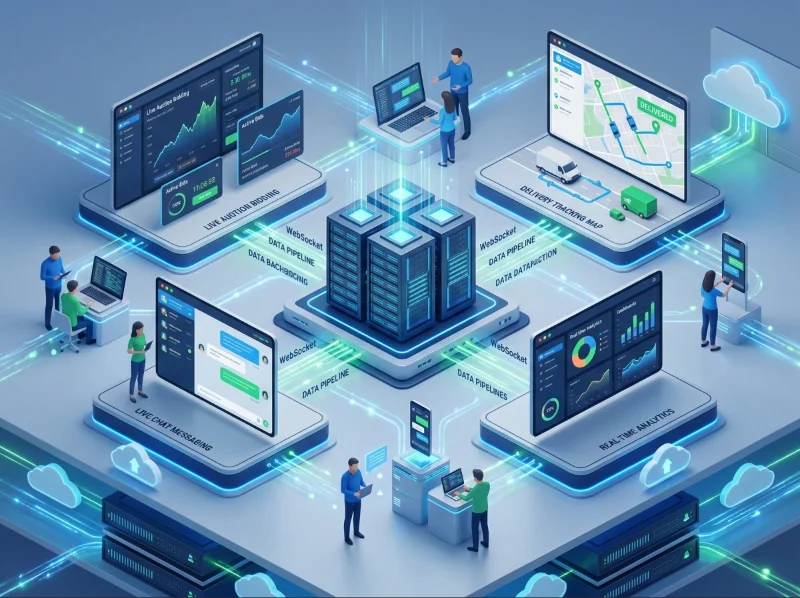
Today, people rarely wait for information to update.
When you book a ride, you expect to see the driver's location moving on the map. When you order food, you want live delivery updates. When you send a message, you expect it to appear instantly. When you bid in an online auction, you expect every bid and countdown change to be reflected immediately.
This shift in user expectations has changed how software is built. Modern users don't just want applications that work—they want applications that respond in real time. As a result, businesses across logistics, finance, e-commerce, healthcare, collaboration software, and customer support increasingly depend on real-time systems.
But before discussing technologies, there is a more important question:
Does the product genuinely require real-time behavior?
The first architecture decision should never be "Should we use Node.js?" It should be: "What level of responsiveness does the business actually need?" Only after understanding that requirement does it make sense to evaluate technologies such as Node.js.
Why Real-Time Experiences Matter Today
A decade ago, users were comfortable refreshing a page to see new information. That is no longer true. Users now expect:
For businesses, this is more than a user experience improvement. Real-time systems can directly impact:
- Customer satisfaction
- User engagement
- Operational visibility
- Response times
- Revenue opportunities
A logistics company benefits when customers can track deliveries in real time. A support platform benefits when customers receive immediate responses. An auction platform benefits when bidders can react instantly to changing prices.
The value of a real-time system comes from reducing the delay between an event occurring and a user becoming aware of it.
Requirements Should Drive Technology Decisions
One of the most common mistakes in software architecture is choosing technology before understanding requirements. A better approach is to evaluate questions such as:
- How many users will use the system?
- How many users will be connected simultaneously?
- How frequently will information change?
- How quickly must updates reach users?
- Are there business-critical transactions?
- How quickly is the platform expected to grow?
- What infrastructure budget is available?
- What technologies does the team already understand?
For example, a reporting dashboard updated every few minutes has very different requirements from a trading platform updating hundreds of times per second. Likewise, a startup serving a few hundred users has different challenges than a platform serving millions.
Requirements should drive technology decisions—not the other way around.
Industries That Depend on Real-Time Systems
Real-time technology is no longer limited to chat applications.
Logistics and Delivery
Drivers, dispatchers, and customers often need synchronized location updates.
Financial Services
Market data, transactions, and alerts frequently depend on low-latency communication.
Auction Platforms
Users need immediate visibility into bids, countdown timers, and auction outcomes.
Healthcare
Monitoring systems often require rapid alerts when critical events occur.
Collaboration Platforms
Teams expect edits, comments, and notifications to appear instantly.
Customer Support
Live chat systems depend on immediate communication between customers and support agents.
Although the industries differ, the objective remains the same: reduce the delay between an event happening and a user receiving that information.
Real-Time Systems: What Actually Makes Them Difficult?
Many developers assume real-time application development is simply a matter of adding WebSockets or Socket.IO. In reality, that is often the easiest part. The real challenges involve synchronization, consistency, and scalability.
Keeping Users Synchronized
When multiple users are viewing the same information, everyone should see the same state. If users see different versions of the truth, trust quickly disappears.
Concurrent Operations
Multiple actions may occur at nearly the same moment. The system must determine how those actions are processed and in what order.
Race Conditions
Race conditions occur when multiple operations attempt to modify the same data simultaneously. Without proper safeguards, unexpected outcomes can occur.
State Consistency
Databases, caches, servers, and connected clients should all agree on the current state of the application. As systems grow, maintaining consistency becomes increasingly challenging.
Timer Accuracy
Countdown timers appear simple. In practice, ensuring accurate timers across thousands of users and multiple servers can become surprisingly complex.
Scaling Persistent Connections
Unlike traditional applications that process a request and disconnect, real-time applications often maintain thousands of active connections simultaneously. Managing those connections efficiently is one of the core architectural challenges.
Real-World Example: Penny Auction Platform
Bidding in the final seconds
One of the more interesting systems I worked on was a penny auction platform where bidding occurred in real time. The most demanding period was always the final seconds of an auction. As the timer approached zero, activity increased dramatically.
Hundreds of users could be watching the same auction. Multiple bids could arrive almost simultaneously. Every successful bid could reset the countdown timer.
From a business perspective, fairness was critical. Users needed confidence that:
- Their bid was accepted correctly
- The displayed price was accurate
- The timer was trustworthy
- The final outcome was legitimate
The challenge was not simply displaying updates on screen. The challenge was maintaining a single authoritative state while many users attempted to change that state at nearly the same moment.
Imagine three bids arriving within milliseconds. The system must determine:
- Which bid is accepted first
- Which bids remain valid
- Whether the timer should reset
- What updated state should be broadcast
At the same time, hundreds or thousands of connected users expect immediate updates.
Real-time systems are primarily about correctness and synchronization.
Technology matters. Architecture matters more.
Node.js proved to be a strong fit for the communication-heavy nature of the platform, but success ultimately came from designing reliable state management and concurrency controls.
Why Node.js Fits Real-Time Applications
Once you determine that real-time communication is genuinely required, the next question becomes: can the backend efficiently handle large numbers of connected users and continuous communication? This is where Node.js often becomes a strong architectural choice.
Event-Driven Architecture
Node.js operates around events. Instead of waiting for one operation to complete before handling another, it reacts to incoming events as they occur.
Why it matters
Real-time systems generate a constant stream of events such as messages, bids, notifications, and updates.
Business impact
The architecture naturally aligns with communication-heavy applications.
Non-Blocking I/O
Many backend operations involve waiting — database queries, API calls, network communication, file operations. Node.js can continue processing other requests while these operations are waiting.
Why it matters
Real-time applications often spend more time communicating than computing.
Business impact
Resources are used efficiently when handling large numbers of concurrent users.
Persistent Connections
Real-time systems frequently rely on WebSockets and long-lived connections. Node.js performs well in environments where users remain connected for extended periods.
Why it matters
Continuous communication is a core requirement for many real-time applications.
Business impact
Users receive updates immediately without constantly refreshing pages.
Mature Ecosystem
The Node.js ecosystem includes widely adopted tools such as:
Business impact
Teams can build, test, and iterate more quickly.
Where Node.js Is a Strong Fit
Auction Platforms
Immediate updates when bids change or timers reset.
Chat Applications
Messages should appear instantly across participants.
Live Tracking Systems
Location updates must be distributed continuously.
Collaboration Software
Multiple users need synchronized edits and changes.
Notification Systems
Events must be delivered quickly to connected users.
Real-Time Dashboards
Metrics and operational data require frequent updates.
Multiplayer Applications
Game state changes need rapid communication between participants.
IoT & Device Telemetry
Sensor and device streams need continuous ingestion and fan-out to dashboards and alerts.
Where Node.js May Not Be the Best Choice
Balanced engineering requires understanding trade-offs. Node.js is not automatically the best backend for every workload.
CPU-Intensive Processing
Applications involving heavy computations, scientific workloads, advanced image processing, or machine learning may benefit from technologies optimized for those tasks.
Existing Team Expertise
Technology decisions should account for hiring, maintenance, and operational costs. A familiar technology stack is often more valuable than a theoretically superior one.
Specialized Industry Ecosystems
Some industries already have mature tooling and frameworks built around alternative platforms. Leveraging those ecosystems can reduce risk.
Mixed Workloads
Many successful systems use multiple technologies. For example:
- Node.js for real-time communication
- Dedicated services for analytics and reporting
- Specialized services for computational workloads
Good architecture is about using the right tool for the right problem.
Architecture Should Evolve With the Business
One of the most expensive mistakes startups make is overengineering.
Keep things simple. A common architecture might include:
- Node.js
- PostgreSQL or MySQL
- Redis
- WebSockets
Often sufficient to validate a product.
Introduce improvements based on measurable needs:
- Load balancing
- Background jobs
- Monitoring
- Better caching
- Database read replicas
Only when justified should teams consider:
- Service separation
- Distributed systems
- Message queues
- Advanced infrastructure
Avoid introducing Kubernetes, Kafka, or microservices simply because they are popular. Complexity should solve a proven problem.
The Most Important Lessons
Concurrency Often Matters More Than Total Traffic
Simultaneous activity can be more challenging than overall volume.
Not Every Feature Needs Real-Time Updates
Use real-time functionality where it provides meaningful value.
Correctness Matters More Than Speed
Fast but incorrect systems create business risk.
Simplicity Reduces Operational Costs
Simple architectures are easier to scale and maintain.
Measure Before Scaling
Use evidence, not assumptions.
Real-Time UX Creates Engineering Complexity
Better user experiences come with additional technical challenges.
Architecture Should Follow Business Requirements
Technology choices should support business goals.
Decision Checklist
Node.js may be a strong candidate if you answer "yes" to most of these:
- Do users need instant updates?
- Are many users connected simultaneously?
- Is low-latency communication important?
- Does the application perform many network operations?
- Are WebSocket applications a major requirement?
- Will users remain connected for long periods?
- Is rapid product development important?
- Does the team already have Node.js expertise?
- Does the workload focus more on communication than heavy computation?
- Is growth expected through increasing concurrent users?
The answer should come from the application's requirements—not from the popularity of a technology.
Frequently Asked Questions
Why is Node.js good for real-time applications?
Can Node.js handle thousands of concurrent users?
Which types of applications benefit most from Node.js?
Does every real-time application need WebSockets?
When should a startup consider Kafka or Kubernetes?
How does Node.js compare with traditional backend technologies?
Conclusion
Real-time systems are no longer limited to chat applications and online gaming. They power delivery tracking, collaborative software, live auctions, financial dashboards, customer support platforms, and many of the digital experiences people use every day.
The important architectural decision is not whether Node.js is popular. The important decision is whether the business problem requires real-time communication.
When users expect immediate updates, many concurrent connections must be maintained, and responsiveness directly affects user experience, Node.js for real-time applications becomes a compelling option.
Need Help Evaluating a Real-Time System?
If you're planning a real-time application, auction platform, Node.js backend, Laravel solution, or scalable web application, start with the requirements first. A short architecture discussion can often prevent months of unnecessary complexity and help identify the simplest path to a scalable solution.