Develop secure, scalable, and high-performance Reverse Auction Software for procurement, supplier bidding, and online auctions. With 20+ years of software development experience, I build custom platforms that speed up procurement, increase supplier competition, and help reduce purchasing costs, with security features such as role-based access, secure authentication, bid validation, activity tracking, audit logs, and protected business data.
Request your free consult now
Reverse auction software is an online platform that helps businesses buy products or services through competitive bidding. Instead of buyers increasing their bids, suppliers compete by offering lower prices to win the order.
A successful reverse auction platform requires more than a bidding interface. It needs carefully designed auction rules, supplier workflows, real-time bid processing, secure data management, user permissions and a reliable architecture that can handle multiple participants at the same time.
With 20+ years of experience in auction software and online bidding systems, I design and develop custom reverse auction software directly around your business requirements.
I work directly with clients throughout the development process, from understanding the procurement workflow and defining auction rules to designing the architecture, developing the application and integrating it with existing business systems.
As a full-stack developer, I can handle both the frontend and backend of the platform. I work with Laravel, CodeIgniter and Node.js for backend development, MySQL, MongoDB and PostgreSQL for databases, and React.js, Vue.js and Tailwind CSS for modern frontend development.
Whether you need an internal procurement auction system, an online supplier bidding platform, a B2B procurement solution or an enterprise reverse auction platform, I can develop the software around the way your business operates.
Every business follows a different procurement process, so a standard auction system may not always meet your needs. I develop custom reverse auction software based on your workflow and bidding rules. Your platform can include features such as supplier pre-qualification, private or blind bidding, multi-criteria supplier evaluation, minimum bid changes, auction extensions, approval workflows, and integration with ERP or accounting systems. The system can also be updated when your procurement process or business requirements change.
My goal is to build a secure, reliable, and scalable reverse auction platform that is easy to manage and ready to grow with your business. Your procurement team can manage suppliers, control bidding rules, compare offers, evaluate suppliers, and manage award decisions from one platform. Whether you need a B2B sourcing solution, raw material procurement system, construction bidding platform, or private supplier auction, I can develop a solution that fits your specific requirements and provides a clear and transparent bidding process.
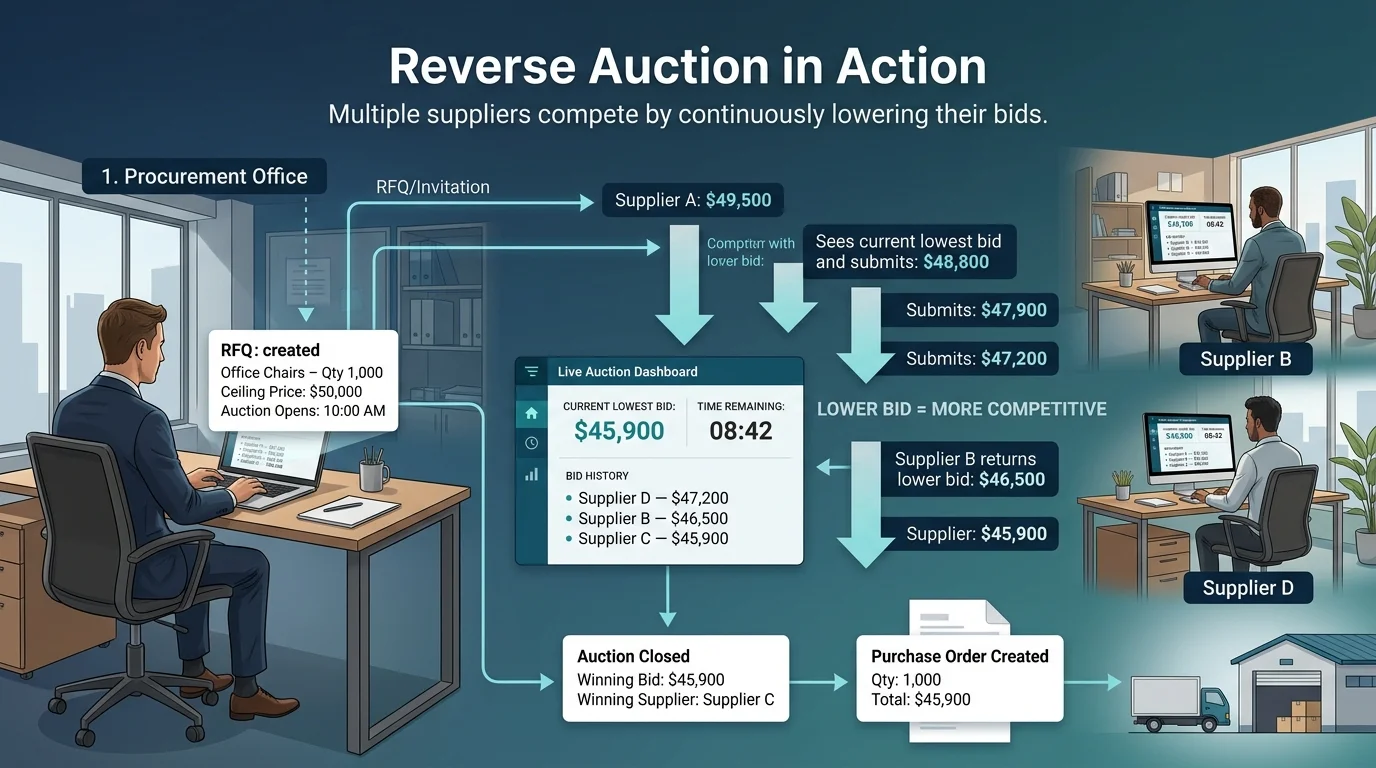
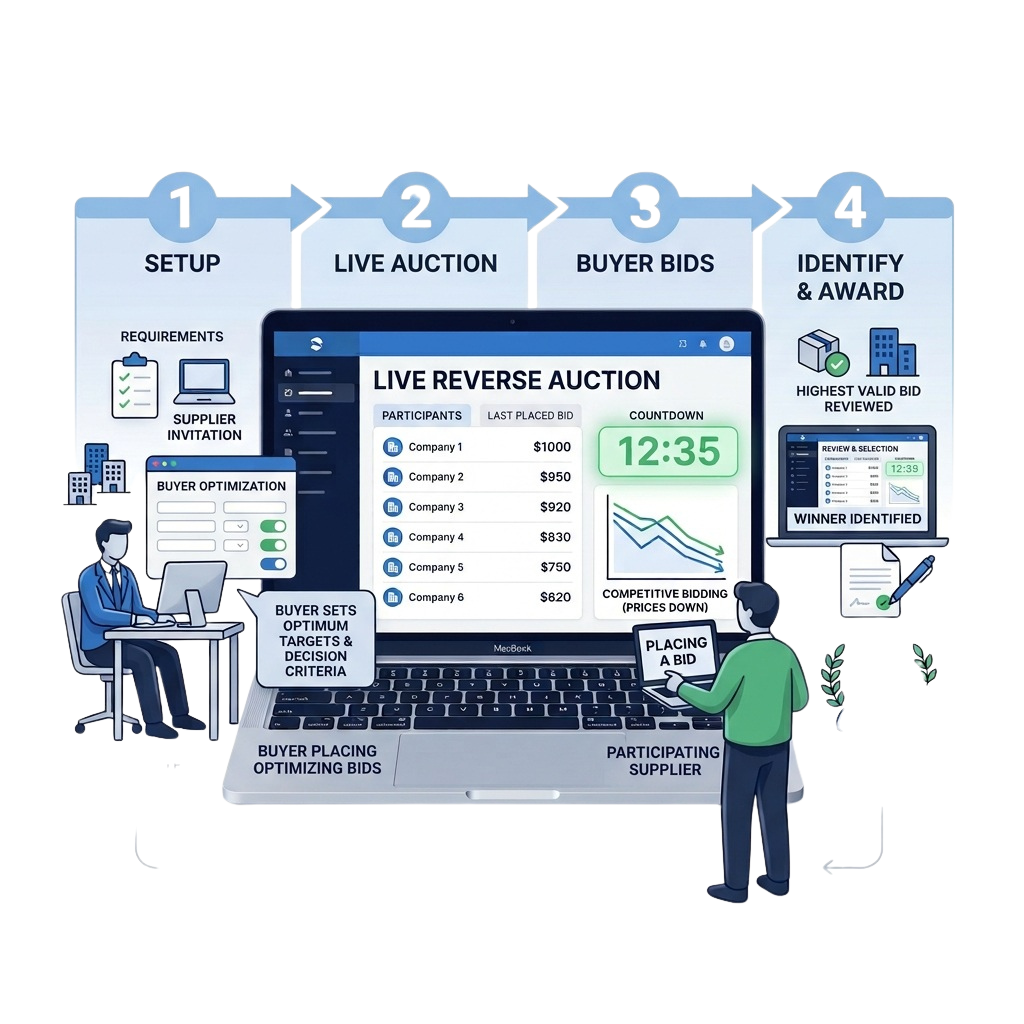
A reverse auction runs on the opposite logic of a normal auction, and the software behind it has to manage that carefully from the request all the way to the awarded contract.
The buyer or procurement team creates an RFQ with the item or service needed, quantity, specifications, delivery timeline, ceiling price, and the criteria that will be used to judge bids.
The buyer invites pre-approved suppliers or opens the RFQ to registration, depending on how the business normally sources this type of item or service.
Depending on the value of the contract, suppliers may need to register, submit documents, or pass a qualification check before they are allowed to bid.
Once the auction goes live, registered suppliers submit their opening bids. The software checks each bid against the ceiling price and bidding rules before it's accepted.
Suppliers watch the current best offer and submit lower bids to stay competitive. Each new bid has to beat the current one by at least the minimum decrement you've set.
When the auction ends, the software ranks valid bids. If price is the only factor, the lowest bid leads. If you use weighted scoring, quality and delivery time can be factored in too.
The buyer reviews the top-ranked bid, or the system can confirm it automatically based on your rules, and the winning supplier is notified.
Once a supplier is confirmed, the system can generate a purchase order, record agreed terms, and move the process into fulfillment and payment.
This lets the reverse auction software manage the full process, from creating a sourcing request and accepting supplier bids to selecting a winner and issuing the purchase order.
Every procurement business has different sourcing rules. I build the software around those rules and can include the features your business needs to manage RFQs, suppliers, bids, approvals, and the complete sourcing process.
Buyers, suppliers, and staff each get their own secure login. You can manage accounts, reset access, and control who is allowed into the platform without extra hassle.
Not everyone needs the same access. Procurement managers, approvers, and suppliers can each see and do only what their role allows, so sensitive bid data stays protected.
Keep supplier profiles, documents, qualification status, and bid history in one place, so your team always knows who they're buying from and how that supplier has performed before.
Create and publish requests for quotation with item details, quantities, deadlines, and evaluation criteria, so suppliers know exactly what you need before they bid.
Schedule auctions, set opening and closing times, and manage multiple live or upcoming auctions from one dashboard, without juggling spreadsheets or email threads.
Every bid a supplier places is validated, ranked, and stored automatically, so you always have an accurate, up-to-date view of where each auction stands.
The system tracks every valid bid as it comes in and identifies the current best offer the moment the auction closes, based on the rules you've set.
Bids can go through a review and approval step before an award is confirmed, so the right people sign off before your business commits to a supplier.
Suppliers and buyers get notified automatically for RFQ invitations, outbid alerts, closing reminders, and award decisions, by email, SMS, or in-app notification.
See RFQ activity, supplier participation, spend by category, and savings achieved through competitive bidding, exportable in formats like Excel, CSV, or PDF.
If you buy from suppliers in different countries, bids and reports can be shown in the currency that makes sense for each business involved.
Suppliers and buyers in different regions can use the platform in their own language, which helps when you're sourcing from an international supplier base.
Where it genuinely helps, AI can support tasks like supplier scoring, bid anomaly detection, or smart RFQ suggestions, without replacing the buyer's final decision.
Administrators get full control over users, auctions, and settings, backed by security practices that keep sensitive pricing and supplier data protected.
Every important action — RFQ changes, bid submissions, approvals, and awards — gets logged, so you have a clear, reviewable history if anyone needs to check what happened.
Connect the platform to your ERP, accounting software, or other business systems through APIs, so awarded orders and supplier data flow where they need to go.
The interface works properly on desktops, tablets, and phones, so a supplier can review an RFQ and place a bid from wherever they happen to be.
Built to handle more RFQs, suppliers, and bids as your sourcing volume grows, without needing to be rebuilt every time your procurement activity increases.
Reverse auction software fits any business or organization that buys products, materials, or services in volume and wants suppliers to compete openly on price and value. Some common sectors include:
Manufacturers can source raw materials, components, and packaging from competing suppliers, helping control production costs without compromising on quality or delivery schedules.
Government departments and public agencies can run transparent, auditable reverse auctions for supplies, equipment, and services, keeping public spending accountable.
Construction companies can source building materials, equipment rentals, and subcontractor bids through competitive reverse auctions, keeping project costs under control.
Businesses can auction freight, shipping, and transportation contracts to carriers competing on rate and service level, lowering delivery costs over time.
Wholesalers and distributors can use reverse auctions to negotiate better prices on bulk inventory from competing suppliers, improving margins on high-volume orders.
Businesses that regularly buy tools, parts, and industrial supplies can run reverse auctions to keep recurring purchase costs down without extra manual negotiation.
Companies that depend on raw materials like steel, timber, or textiles can source from multiple suppliers competing on price, quality, and delivery time.
Businesses can source machinery, tools, and equipment through competitive bidding, comparing offers from multiple vendors before committing to a purchase.
Hospitals and healthcare networks can source medical supplies, equipment, and services while keeping quality standards and compliance part of the evaluation.
Companies can source software licenses, IT hardware, and technical services through structured, competitive bidding rather than accepting the first quote received.
Businesses can source legal, consulting, marketing, or other professional services by inviting firms to bid, comparing pricing alongside experience and scope.
B2B marketplaces can offer reverse auction functionality so registered buyers and suppliers can trade through a shared, competitive sourcing platform.
A reverse auction has its own tricky edge cases — two suppliers landing on the exact same price, a bid that technically beats the decrement but not by enough, a tie that needs a fair tiebreaker. I've been working through problems like these for over 15 years, on top of 20+ years writing software in general.
I'm an individual freelance developer, not a company with account managers passing messages along. When you want to ask how a multi-criteria score should be weighted, or change a rule halfway through the project, you're talking to the person actually writing the code.
You communicate directly with me throughout the project. There is no unnecessary communication gap between you and the person understanding your requirements and developing the software. This makes it easier to discuss sourcing rules, explain changes, solve technical issues, and make decisions quickly.
Your first version of the platform may not contain every feature you eventually need. The software can be designed with a modular architecture so new evaluation criteria, integrations, user roles, and sourcing workflows can be introduced as your platform grows.
Frontend, backend, database, and API work is handled together, so the bidding experience and the admin systems behind it work reliably as one application.
Every project has different requirements. Whether you are starting a new sourcing platform, developing software for your client, or working on an existing application, the development approach can be discussed around the actual scope and requirements.
I follow a clear development process to make sure the sourcing platform is built around your actual procurement requirements. The process can vary depending on the project, but I normally follow these steps.
I first understand your sourcing model, buyer and supplier roles, evaluation criteria, approval process, and day-to-day workflow. I also look at any existing systems that need to connect with the new platform.
I design the interfaces for buyers, suppliers, and administrators based on how they will actually use the system. The goal is to keep the interface simple, clear, responsive, and easy to use.
I develop the core RFQ and bidding functionality, including bid validation, decrements, ceiling prices, multi-criteria scoring, auction extensions, and winner determination.
I build the backend, database structure, APIs, business logic, integrations, notifications, and administrative functions required for the platform.
For live bidding, I implement real-time rank updates, countdown timers, outbid notifications, and other features that need to update without a page refresh.
I test the normal bidding process along with situations that can cause problems, including multiple suppliers bidding at the same time, tied bids, auction closing, extensions, and permission issues.
Once the platform is ready, I help with deployment and can continue working on the system after launch — new features, integrations, performance improvements, bug fixes, and maintenance as your sourcing needs grow.
Yes. I can build a reverse auction system based on your business requirements. Whether you need a simple bidding system or a complete procurement solution, I can customize the features and workflow to match your needs.
I can help with the complete development process, including planning, UI design, development, database setup, testing, deployment, and ongoing improvements. I can also add new features to an existing system.
I use modern and reliable web technologies based on the project requirements. The technology stack is selected based on factors such as performance, security, scalability, and the features your reverse auction system needs.
Yes, I have a ready reverse auction solution that can be customized to fit your business requirements. If you need something different, I can also build a reverse auction platform from the ground up with your preferred features, workflow, and business rules.
It depends on the features and complexity of the project. A basic reverse auction system can be completed faster, while a larger platform with custom workflows and integrations will take more time. After discussing your requirements, I can give you a more realistic timeline.
Yes. The system can be customized to consider other factors such as delivery time, supplier rating, quality, payment terms, or other criteria that are important to your business.
Yes. The bidding process can be configured so suppliers cannot see the exact prices submitted by other suppliers. The information shown to suppliers can be controlled based on your auction rules.
Yes. If you already have a reverse auction or procurement system, I can help improve it. This can include adding new features, fixing issues, improving performance, updating the design, or changing the existing workflow.
Yes. I can provide ongoing support after the system goes live. This can include bug fixes, updates, performance improvements, security updates, and adding new features when needed.
Yes. I can integrate the reverse auction system with your ERP, accounting software, CRM, payment system, or other business tools through APIs or suitable integration methods. The exact approach depends on the software you use and what data needs to be shared.
A reverse auction isn't the right fit for every business. If you need buyers competing to bid higher instead of suppliers bidding lower, I build that too.
Whether you are setting up a new sourcing platform, adding reverse auction features to an existing system, or improving one you already have, I am happy to discuss your requirements and find a practical way forward.
Whether you're starting fresh or enhancing an existing system, I offer custom software development services built to match your goals. From responsive web apps to powerful backend solutions and mobile integrations, explore how each service can help your business move forward with confidence.
I optimize your website or app for speed, mobile performance, and technical SEO to help you deliver faster experiences and build a strong foundation for better search visibility and user engagement.
I provide reliable maintenance and support to keep your applications secure, updated, and running smoothly. This includes bug fixes, content updates, performance improvements, backups, upgrades, and issue resolution.
I create visually appealing, conversion-driven designs that prioritize usability and your brand identity. Every layout is built to be responsive and intuitive for your target audience.
Technologies and tools I use to deliver reliable, high-quality web and mobile application for clients worldwide.
PHP
Laravel
CodeIgniter
WordPress
Node.js
NestJS
JavaScript
TypeScript
React
React Native
Next.js
Vue.js
Bootstrap
Tailwind CSS
MySQL
MongoDB
PostgreSQL
HTML
CSS
jQuery
GitHub
VS Code
AI
Claude