Senior NestJS Developer & Software Architect with 20+ years of software development experience. I build structured, secure, and scalable backends and APIs with Express.js, Node.js, NestJS, and TypeScript, helping businesses create maintainable, modern enterprise applications.
Request your free consult now
I am a freelance NestJS developer and software architect based in Nepal, with more than 20 years of experience in software development. I design and build secure, scalable, and maintainable backend systems for startups, growing businesses, and enterprises, including APIs, SaaS platforms, multi-tenant applications, enterprise systems, and real-time applications. You work directly with me throughout the process, from the initial discussion and architecture planning through development and launch.
NestJS, built on Node.js and TypeScript, provides a structured foundation for building complex backend applications. I use its modular architecture, Domain-Driven Design (DDD) approach, controllers, services, dependency injection, guards, pipes, and other capabilities to keep backend systems organized, testable, and maintainable as they grow. But good architecture is about more than following a framework's structure. It requires understanding how the entire system should work.
Before writing code, I look at your business requirements, data, users, integrations, security needs, and future growth. I carefully define the boundaries between features and responsibilities so the architecture remains clear as new functionality and developers are added. Getting these architectural decisions right early can prevent costly refactoring and technical debt later.
For SaaS and multi-tenant applications, I pay particular attention to tenant isolation, authentication and authorization, role-based access control, data security, scalability, and maintainability. I design backend architectures that can support multiple customers and growing workloads while keeping the codebase organized and the business logic easy to evolve.
Whether you're launching a new SaaS product, building an API-driven application, modernizing an existing backend, or developing a complex enterprise system, I can help you establish a solid NestJS architecture and build a backend that is secure, reliable, scalable, and ready for long-term growth.
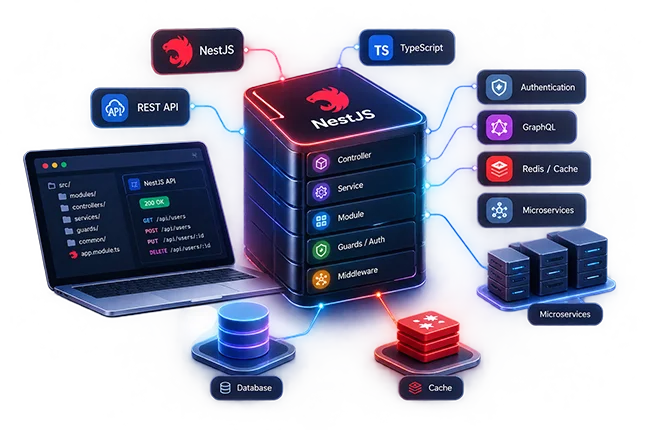
The main idea of NestJS is that every request takes the same predictable path. Each step has one job, so problems are easy to find and easy to fix.
STEP 1
Request
A user or an app calls your API
STEP 2
Guard
Checks who is calling and what they may do
STEP 3
Pipe
Validates the data before it is used
STEP 4
Controller
Receives the request and decides what to call
STEP 5
Service
Holds the business rules of your product
STEP 6
Database
Stores and returns your data
Interceptors sit around this path to add logging, caching, and consistent responses, and each feature of your product lives in its own module.
NestJS pays off when a backend is large, long-lived, or worked on by more than one person. These are the projects I use it for.
REST APIs
Clean, documented APIs for your website and mobile apps, with validation on every request.
GraphQL APIs
For products where clients need to ask for exactly the data they want, in a single request.
Integrations and Webhooks
Payments, third-party services, and connections to the other systems your business uses.
SaaS Backends
Multi-user products with roles, permissions, subscriptions, and separate data for each customer.
Real-Time Systems
Live updates, notifications, chat, and dashboards using WebSockets.
Backends for Web and Mobile Apps
One API that serves your React or Next.js website and your mobile app together.
Queues and Background Jobs
Emails, reports, imports, and other slow work that should never make a user wait.
Microservices
A large system split into smaller services that talk through queues or messages. I only recommend this when it really helps.
Monitoring and Logging
Structured logs and health checks, so problems in production are found before users report them.
NestJS is not always the right answer. For a small project it can be more structure than you need. Here is how I decide with clients.
There is no score to add up. If most answers are yes, NestJS will probably serve you well.
You need a small API, a prototype, or a simple service where speed of delivery matters more than structure. See my Node.js development service.
You want a business application or a SaaS first version delivered fast, with login, queues, and admin tools ready to use. See my Laravel development service.
I split the code by business area first, using Domain-Driven Design, and give each use case its own vertical slice. Structure is the whole reason to choose NestJS, so I take it seriously from the first day.
src/
├── main.ts
├── app.module.ts
├── modules/
│ ├── orders/ # bounded context
│ │ ├── domain/
│ │ │ ├── order.entity.ts
│ │ │ ├── order-status.vo.ts
│ │ │ └── order.repository.ts
│ │ ├── application/
│ │ │ ├── place-order/ # one slice
│ │ │ │ ├── place-order.command.ts
│ │ │ │ ├── place-order.handler.ts
│ │ │ │ └── place-order.handler.spec.ts
│ │ │ └── get-order/
│ │ ├── infrastructure/
│ │ │ └── typeorm-order.repository.ts
│ │ ├── presentation/
│ │ │ ├── orders.controller.ts
│ │ │ └── dto/create-order.dto.ts
│ │ └── orders.module.ts
│ ├── billing/
│ └── identity/
└── shared/
└── domain-events/
Each business area is a module, and each use case is a slice inside it. Dependencies point inward, toward the domain.
In a SaaS product, many customers share one application, but no customer may ever see another customer's data. How to keep that data apart is one of the first decisions I make with you.
Every row carries the customer's ID, and the backend adds that filter to every query automatically. The simplest and cheapest setup to run.
Good for: most new SaaS products and first versions.
Each customer gets their own set of tables inside one database. Stronger separation, with a little more work for every database change.
Good for: products with stricter separation needs or a few large customers.
Each customer has a completely separate database. The strongest isolation, and the highest cost to run and maintain.
Good for: enterprise or regulated customers who require it.
Whichever model fits, I enforce the tenant check in one place, with a guard and a data layer that is scoped to the current customer, instead of adding filters to every query by hand. Then I add tests that try to read another customer's data and must fail.
NestJS is the foundation. These are the tools I usually build on top of it. Message brokers like RabbitMQ or Kafka only come in when a project really needs them.
TypeScript on Node.js, so many mistakes are caught while coding.
Chosen with you based on how your data looks and how it will be used.
The library that talks to the database, picked to suit the project.
The right style for each product, documented for whoever uses it.
Slow or scheduled work moved out of the request.
Tests and repeatable deployments, so releases are not stressful.
Many Node.js and NestJS backends start simple and slowly become hard to change. This is the kind of change I make when I take one over.
Review
I read the code and list the problems in order of impact.
Stabilize
The riskiest parts are fixed first, with tests around them.
Move step by step
Features move into NestJS one at a time while the API keeps running. NestJS runs on Express by default, so this needs no rewrite.
Four phases. Here is what I do in each one, and what I need from you.
I: learn your business, data, and integrations.
You: share requirements, documents, and any system access I need.
I: design the modules, the database, and the API, and send a quote.
You: review and approve the plan.
I: build feature by feature with tests, and share a running version early.
You: try it and give feedback as it grows.
I: deploy the backend, hand over the documentation, and stay available for fixes.
You: confirm it works for your users and tell me what you see.
A focused API can take a few weeks. Larger systems are built in phases so you can start using the first part early. I give you a realistic timeline once I understand the scope.
I quote per project after we talk. These are the factors that move the price the most, and when each one adds the most.
Adds the most when there are many endpoints with complex business rules.
Adds the most when there are many roles, or each customer has separate data.
Adds the most when payments, third-party APIs, WebSockets, or queues are involved.
Adds the most when data volumes are large, reports are heavy, or speed targets are strict.
Adds the most when you need high test coverage or public API docs for partners.
Adds the most when the backend runs on your own servers with monitoring and ongoing support.
For a large backend I suggest phases, so you are never asked to commit to everything at once.
PHASE 1
The core API and login, so you have something real to use early.
PHASE 2
Integrations, background jobs, and the next set of features.
PHASE 3
Reporting, scaling work, and the extras that can wait.
A backend is the part of your product that is hardest to change later. It is worth having someone who has seen many of them grow.
The same person plans the system and writes it, so nothing is lost between design and build.
I work with NestJS, Node.js, Laravel, and PHP, so my advice is not tied to one tool.
Tenant isolation, roles and permissions, and clear domain boundaries in products used every day.
Clear modules, validated data, and tests mean a new developer can join without weeks of confusion.
If plain Node.js or Laravel fits your project better, I will tell you and explain why.
The repository, servers, and accounts stay in your name, so you are never locked in to me.
Answers to what clients ask most before starting a NestJS backend. Have a different question?
Ask me directlyIt depends on the number of features, the integrations, and how much testing and documentation you need. A focused API costs much less than a full SaaS backend. After we talk I send a quote for a clear scope, and for larger systems I suggest phases.
NestJS is a framework built on Node.js that gives your backend a standard structure of modules, controllers, and services. Plain Node.js leaves every structure decision to the developer. For a large or long-lived application, the standard structure keeps the code organized and easier to hand over.
Sometimes, yes. For a small API or a quick prototype, plain Node.js is often faster to build and simpler to run. I will tell you honestly which one fits your project. See my Node.js development service.
Laravel is usually the faster route for business applications and first versions of a SaaS product, because login, queues, and admin tools are ready to use. NestJS is a better fit for real-time systems, microservices, and teams that want TypeScript across the whole product. I build both, so I can give you an unbiased answer.
Yes. NestJS supports WebSockets for real-time features and message based communication for microservices. I only recommend microservices when a project really needs them, because a well-structured single application is simpler to run and cheaper to maintain.
Yes. I choose how to keep each customer's data apart, with shared tables and a tenant ID, a schema per tenant, or a database per tenant, based on your security needs, size, and budget. The tenant check lives in one place, so no query can leak data between customers.
Yes. I start by reading the code and listing the problems in order of importance. If moving to NestJS makes sense, I migrate one feature at a time so your API keeps working throughout, with no big-bang release.
A focused API can take a few weeks. Larger systems take longer and are built in phases so you can use the first part early. I give you a realistic timeline once I have seen the requirements.
The right tool depends on your project. These related services may be a better match, or a good partner for your backend.
Tell me what you want to build, or what is wrong with your current backend. I will reply personally with honest advice and an estimate. From the first call to launch, you work directly with the developer and architect who plans and writes your code.
A few lines on each is enough. The more I know, the more useful my first reply will be.
Prefer email? Write to contact@sks.com.np
Whether you're starting fresh or enhancing an existing system, I offer custom software development services built to match your goals. From responsive web apps to powerful backend solutions and mobile integrations, explore how each service can help your business move forward with confidence.
Your website or web application needs care long after launch. I keep it secure, fast, and working, with bug fixes, updates, backups, monitoring, and a developer you can actually reach. With 20+ years of experience, I look after custom systems, including ones built by other developers.
I develop secure, scalable auction and bidding platforms with real-time bidding, auto-bid, countdown timers, notifications, payment integration, and fully customized solutions for marketplaces and auction-based businesses.
Whether it's a personal portfolio, startup landing page, or complex web platform, I deliver high-quality, SEO-friendly websites with clean architecture and strong technical foundations.
Technologies and tools I use to deliver reliable, high-quality web and mobile application for clients worldwide.
PHP
Laravel
CodeIgniter
WordPress
Node.js
NestJS
JavaScript
TypeScript
React
React Native
Next.js
Vue.js
Bootstrap
Tailwind CSS
MySQL
MongoDB
PostgreSQL
HTML
CSS
jQuery
GitHub
VS Code
AI
Claude